
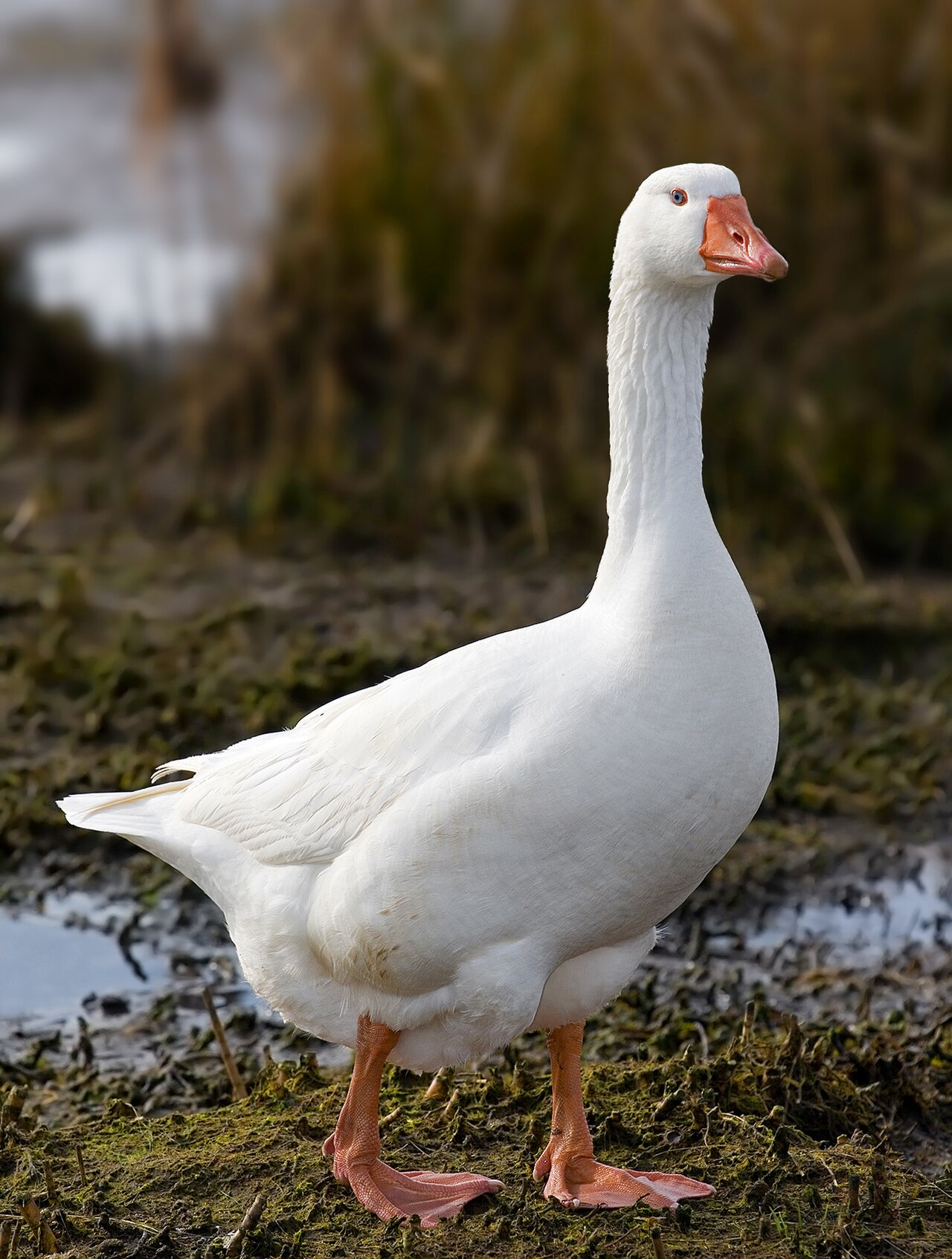
This reference uses the specific documents linked in the article and listed below. Check their scope, publication dates and the statements they support.
Animal at a glance
| Topic | Overview |
|---|---|
| Animal group | Waterfowl with distinct breeds and growing or breeding groups |
| Production roles | Food birds, breeding stock and other farm products |
| Life stages | Gosling, growing goose and breeding adult |
Choose the flock for its purpose
Geese may be raised as seasonal meat birds or maintained as breeders. Breed, mature size and production objective affect feed, space and handling. Before starting, arrange predator protection, a dry night shelter, suitable water equipment and a realistic destination for the birds or their offspring.
Domestic geese are livestock rather than interchangeable substitutes for wild geese. A wild bird feeding nearby does not establish what a confined growing flock can obtain from a paddock. Examine the actual forage and the pressures created by repeated use of the same site.
Grazing supports feeding but does not settle it
Geese can make good use of appropriate grazing, yet quality and quantity change through the year. Goslings, growing meat birds and laying breeders do not share identical requirements. Plan supplementary or complete feed around the stage and available forage rather than using one seasonal grain allowance for everything.
Small-scale poultry production: feed resources describes feed resources in small-scale poultry systems. Use that broader context alongside goose-specific advice. Check the intended species and additives of purchased feeds, and prevent a complete ration from being diluted unpredictably with large amounts of low-quality extras.
Water needs to be accessible whenever birds feed. Check for fouling and congestion, especially at popular grazing-resting junctions. An open container can become dirty quickly. Its placement and drainage should allow drinking without turning the only entrance to shelter into deep mud.
Manage grazing to retain useful plant cover. Continuous concentration near a gateway or trough can damage the ground even when the rest of the paddock looks green. Avoid assuming geese will safely remove every unwanted plant; identify hazards and evaluate what they actually consume.
Protect goslings during the transition outdoors
Artificially reared goslings require a prepared brooding environment with suitable warmth, dry footing, food and safe water. Observe comfort and feeding rather than relying entirely on equipment settings. A young bird huddling or failing to feed needs attention before it becomes visibly wasted.
Outdoor introduction should account for development, weather, shelter and supervision. Do not confuse the ability to walk and graze with the ability to cope with prolonged chilling or predation. Plan bathing or water access for the size and experience of the birds; an adult arrangement can be unsafe for young stock.
The poultry brooding guide explains general principles, while goose-specific care should govern the details. Avoid keeping growing birds on the same equipment and space allowance simply because it worked at arrival.
A waterfowl house still needs dry litter
Provide dry resting litter, fresh air and protection from weather and predators. Wet caked material around drinkers should be removed and its cause corrected. A goose’s comfort in water does not make a permanently wet sleeping area satisfactory. Management of backyard poultry gives useful context on litter, moisture and ventilation.
Night accommodation should be secure and easy for the whole flock to use. Check sharp edges, trapping gaps and slippery approaches. Large birds need room to move without pushing smaller companions into corners. Observe the process of shutting the flock in rather than assuming that an intact door guarantees a safe routine.
Shade and drinking access matter during hot weather. In cold or wet conditions, look at the birds’ ability to reach a dry refuge. Shelter placement and ground drainage often determine whether a simple structure functions well.
Breeder management is its own production stage
Breeding success depends on more than egg count. Breeder condition, mating compatibility, nutrition, egg hygiene and incubation all influence the outcome. Goose production: breeder flock management explains the relationship between feeding the breeder flock, fertility and hatchability.
Provide nesting arrangements suited to the group and protect eggs from heavy fouling. Watch for excessive mating pressure, injuries or birds excluded from feed. Breeding-season aggression also requires safe human handling; a familiar goose may become more defensive around a nest.
Plan the number of goslings the farm can rear before setting eggs. Surplus birds need an appropriate destination, and a high hatch does not compensate for inadequate rearing space. Continuing breeders require year-round care even if the main product is seasonal.
Prevention and useful warning signs
Source birds responsibly and manage contact with other poultry and wild waterfowl. Separate newcomers under a suitable introduction plan. Do not assume that geese are outside poultry disease concerns because they graze outdoors.
Seek prompt advice for sudden deaths, breathing difficulty, nervous signs, marked weakness, persistent diarrhoea or a major change in feeding or laying. Injuries and lameness deserve attention before the animal can no longer follow the flock. Avoid moving suspect birds to markets or other holdings while a contagious problem is being assessed.
Can a goose flock live on grass alone?
Do not assume so. Adequacy depends on forage, season, stage and production demands. Breeders and young birds need particular nutritional planning.
Do domestic geese need a pond?
Water provision should meet the birds’ behavioural and hygiene needs safely within the system. A poorly maintained pond is not automatically a better arrangement than well-designed managed water access with dry resting space.
Field guides for this animal
Browse all Goose field guides for husbandry advice, health explanations and practical farm routines.
Cite this reference
LivestockDefense. “Geese: grazing, breeding, growing birds and flock health.” Updated 2026-11-02. https://livestockdefense.com/animals/geese/
Add the date you accessed the page. This identifies the current reference; keep a permitted saved copy if your work depends on its exact wording. A citation alone does not establish support for a claim.
How to cite a page and its revision ↗Sources & boundaries
Read the evidence in context.
These documents support the statements identified in this reference. Check their scope and dates when deciding whether they answer your question.
- FAO: Small-scale poultry production: feed resources
Source update: Not provided. Most recent check: 2026-11-02.
Bounded species biology, feeding context and production or husbandry statements attributed to this document in the animal overview sections. No numerical feeding, medication, restraint or breeding protocol reproduced.
- FAO: Small-scale poultry production: species and breeds
Source update: Not provided. Most recent check: 2026-11-02.
Bounded species biology, feeding context and production or husbandry statements attributed to this document in the animal overview sections. No numerical feeding, medication, restraint or breeding protocol reproduced.
- Merck Veterinary Manual: Management of backyard poultry
Source update: Not provided. Most recent check: 2026-11-02.
Dry litter, ventilation, clean water and complete life-stage feed.
- FAO: Goose production: breeder flock management
Source update: Not provided. Most recent check: 2026-11-02.
Breeder nutrition, fertility and hatchability; not a universal ration.