
This reference uses the specific documents linked in the article and listed below. Check their scope, publication dates and the statements they support.
The female's short adult season must meet the crop
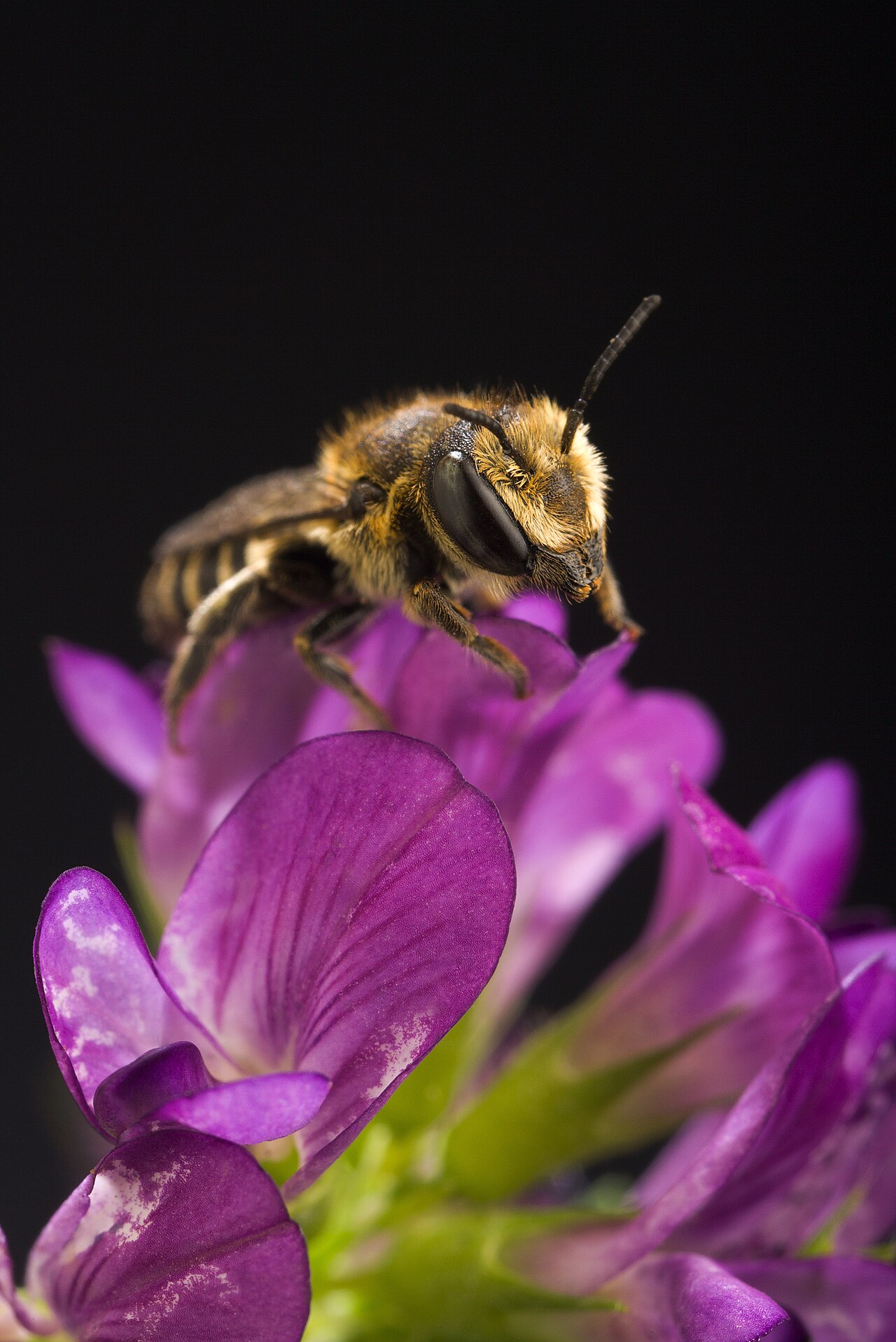
USDA ARS describes Megachile rotundata as a solitary bee: each female provisions individual leaf-lined nest cells. Offspring overwinter as prepupae before completing development. Unlike a honey bee colony with overlapping worker generations, a managed lot offers a more concentrated emergence and adult-use period.
The crop and bee therefore have separate biological clocks. The purpose is not merely to produce many adults, but to have suitable active females present when flowers need visits. A successful storage outcome can coexist with a poor crop match if those two timelines were planned independently.
First male emergence is not peak female availability
The SARE management chapter describes males beginning to emerge before females under its controlled conditions. Counting every emerging adult as equally informative can therefore make the pollination force appear ready earlier than it is. Keep male and female observations distinct where an experienced manager can identify them reliably.
Plot the cumulative female emergence against the proportion of the field in useful bloom. These are different measurements, so label them separately. A date called “bees ready” is difficult to interpret unless it states whether it means first adults, a specified female-emergence stage or actual field activity.
Storage history affects the starting point
SARE explains how refrigeration and incubation influence dormancy and emergence, and warns that prolonged unsuitable storage can deplete reserves or increase losses. The previous temperature history matters; the incubator start date is not the bee's entire developmental history. Different lots may respond differently even when warmed on the same calendar date.
Preserve lot identity from supplier or storage through release. If trays with distinct histories are pooled before emergence is measured, it becomes harder to separate a true timing shift from different survival or developmental distributions. Retain the supplier's information without treating a standard calendar as proof of what the current lot experienced.
Daily temperature cycles can change synchrony
An ARS primary-study summary reports that daily thermal cycles synchronized emergence compared with constant conditions in the tested bees. The study also found that the thermal cycle affected when peak emergence occurred within the day. This shows that incubation is more than accumulating a fixed number of warm days.
It does not establish a universally optimal commercial setting or guarantee better yield in every field. Translate research into a local programme with an experienced leafcutting-bee specialist, accounting for equipment, lot history and crop development. Avoid changing several variables at once and attributing the result to whichever change seemed most interesting.
Timing failure and poor survival require different responses
The uploaded profile makes a useful distinction: healthy emergence after flowering peak is a timing problem. ARS separately describes immature mortality from parasites, chalkbrood and other causes. Few active adults can therefore mean delayed development, loss of viable bees or both; those possibilities should not be combined into one “late bees” label.
Compare the expected viable population with actual emergence, and have a qualified specialist investigate unexpectedly poor survival. A mismatch cannot be repaired simply by assuming more heat will produce adults. An intervention aimed at development may be inappropriate when the underlying lot has already suffered substantial mortality.
Release decisions must include present conditions
SARE discusses delayed release when bloom or weather is unsuitable, while also describing developmental constraints and the need to care for emerged bees. Holding is not unlimited storage. Ask what options are appropriate for the actual developmental stage before attempting a temperature change based on another manager's calendar.
Review crop protection work with the grower before release. Healthy bees synchronized with bloom can still encounter an unsuitable field condition. The bee supplier, crop manager and pollination specialist need one current plan for timing, rather than separate dates that were never compared.
Questions about emergence mismatch
Are these honey bee colonies?
No. M. rotundata females are solitary nesters, even when many nest near one another. Colony-based disease assumptions should not replace their own biology.
Does a warm room guarantee uniform development?
No. SARE emphasizes circulation and avoidance of hot and cold spots. The recorded air setting does not by itself establish conditions throughout all trays.
What outcome should be reviewed after the season?
Compare viable stock, female emergence, bloom overlap and observed field activity. Each explains a different part of pollination performance; seed yield alone cannot identify which timing step succeeded or failed.
Cite this reference
LivestockDefense. “Alfalfa leafcutting bee emergence: matching active females with bloom.” Updated 2026-10-29. https://livestockdefense.com/threats/alfalfa-leafcutting-bee-emergence-timing-mismatch/
Add the date you accessed the page. This identifies the current reference; keep a permitted saved copy if your work depends on its exact wording. A citation alone does not establish support for a claim.
How to cite a page and its revision ↗Sources & boundaries
Read the evidence in context.
These documents support the statements identified in this reference. Check their scope and dates when deciding whether they answer your question.
- USDA Agricultural Research Service: Alfalfa Leafcutting Bee (ALCB)
Source update: Not provided. Most recent check: 2026-10-29.
Solitary nesting life cycle, overwintering prepupae, managed emergence/bloom relationship and separate immature mortality causes. Historic pesticide practices not transferred.
- USDA Agricultural Research Service: Thermoperiodism synchronizes emergence in the alfalfa leafcutting bee
Source update: 2016-02-19. Most recent check: 2026-10-29.
Primary study summary: tested daily thermal cycles synchronized adult emergence. Exact study identifier retained; no universal commercial programme inferred.
- Sustainable Agriculture Research and Education: Storage, Incubation, and Emergence
Source update: 2010. Most recent check: 2026-10-29.
Storage/incubation influence, sex-specific emergence sequence, uneven temperatures and constraints on delaying release. No pesticide protocol reproduced.