
This reference uses the specific documents linked in the article and listed below. Check their scope, publication dates and the statements they support.
Gill structure explains the respiratory concern
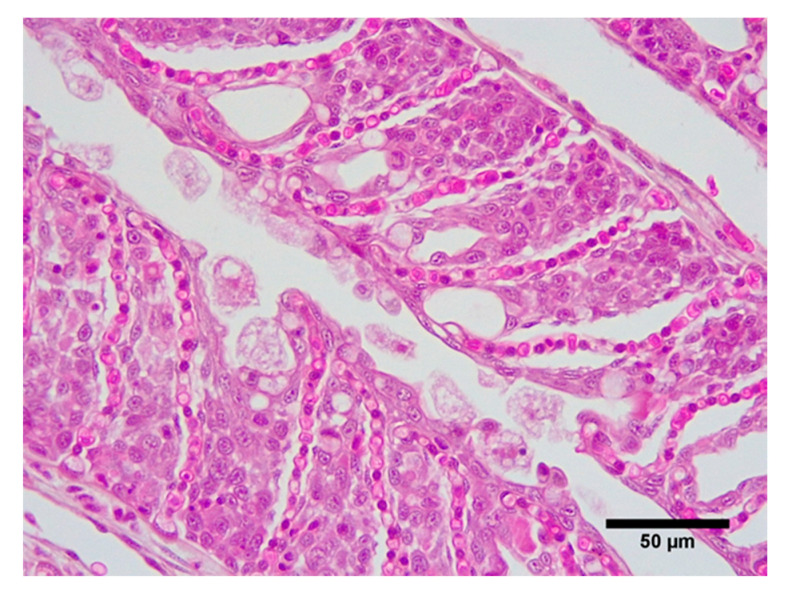
The Scottish Government reference describes proliferative gill disease, increased mucus and swollen white patches. Fish may breathe rapidly or remain near the surface. These observations concern an organ central to the fish's contact with the surrounding water, rather than identifying the cause by behavior alone.
The Norwegian Veterinary Institute describes fusion of respiratory surfaces and increased mucus activity in AGD. Keeping the lesion separate from a general respiratory-distress label helps a fish-health professional decide which evidence is needed.
Two names point to the same amoeba
The Norwegian reference lists Paramoeba perurans and Neoparamoeba perurans as synonyms. Retain the name printed on an older report while joining it to the same subject. A naming change should not create a second disease record or make the earlier diagnosis disappear.
This also helps literature review. Search terms can include both names, but the article or laboratory document still needs to identify the actual organism and method. A paper about another gill-associated amoeba should not be silently treated as evidence about P. perurans.
A white patch is a finding, not an exclusive signature
Both official references describe gill findings, and the Norwegian institute explicitly notes that other conditions can produce similar changes. Fish may have more than one gill insult. Keep environmental measurements and the wider diagnostic findings alongside the suspected AGD assessment.
Record which fish were examined, their group and why they were selected. A few visibly affected fish can provide valuable diagnostic material without being a random sample of the entire cage. A gill-score summary should retain the scoring system and experience of the assessor, especially after repeated interventions.
Molecular detection and disease confirmation differ
The Scottish reference lists histopathology and molecular testing; the Norwegian institute emphasizes histology with PCR for confirmation. It also notes that PCR screening may detect the amoeba without AGD necessarily developing. A positive target result is therefore not the same as a complete explanation of current mortality.
An illustrative report might contain “amoeba detected” and a separate description of complex gill pathology. Preserve both statements. Ask the fish-health professional which lesions support AGD and what other findings contribute to the case. Do not collapse the report into one organism name because it is the first positive result.
Environment affects risk without supplying an absolute cutoff
The Norwegian reference associates risk with salinity and warmer seawater but also reports occurrence outside the commonly emphasized conditions. A temperature or salinity value alone cannot be used to exclude the disease in a compatible case.
Keep sensor location, depth, time and calibration context with measurements. A daily surface reading and a reading at the fish's location are different observations. Comparison is more useful when the team knows which environmental condition each value actually represents.
Control needs a fish-health plan
The Norwegian institute describes professionally managed treatment and repeated monitoring, with incomplete reliability and possible recurrence. It does not identify a universal method that prevents every outbreak. This reference provides no bath recipe, exposure duration or chemical instruction.
Interventions must account for the stock's condition and other gill-health concerns. Record the approved plan, actual group treated and the follow-up findings. The aquaculture hub helps connect the disease episode with stock movements and system history.
Does an improved gill score prove the amoeba has disappeared?
It describes a change in the assessed lesion score. Whether the organism remains detectable or the wider clinical problem is resolved requires the chosen follow-up evidence. Keep those endpoints separate.
Can historic country reports establish a present farm outbreak?
No. They establish a dated reference context. A particular site's disease status needs its own clinical and diagnostic evidence, with location and dates retained. Avoid turning a map or older occurrence description into a current statement about every salmon farm in a region.
Compare like scoring systems
A numerical gill score should name the scale used. A two-point change on one scale cannot automatically be equated with two points on another, and a changed sampling selection can alter the summary. Ask the fish-health team to reconcile those details before using a score trend as the sole measure of treatment success.
Cite this reference
LivestockDefense. “Amoebic gill disease in salmon: lesions, oxygen exchange and diagnosis.” Updated 2026-10-28. https://livestockdefense.com/threats/amoebic-gill-disease-salmon/
Add the date you accessed the page. This identifies the current reference; keep a permitted saved copy if your work depends on its exact wording. A citation alone does not establish support for a claim.
How to cite a page and its revision ↗Sources & boundaries
Read the evidence in context.
These documents support the statements identified in this reference. Check their scope and dates when deciding whether they answer your question.
- Scottish Government Marine Directorate: Amoebic gill disease: diseases of wild and farmed finfish
Source update: 2023-01-11. Most recent check: 2026-10-28.
Amoebal cause, proliferative gill lesions, respiratory appearance and histopathology/PCR diagnostic methods. Historical geographic wording is not a current outbreak claim.
- Norwegian Veterinary Institute: Amoebic gill disease
Source update: 2026-06-23. Most recent check: 2026-10-28.
Paramoeba/Neoparamoeba synonym, gill effects, environmental risk context, PCR detection without disease and professionally planned treatment/monitoring limits. No bath concentration or duration.