
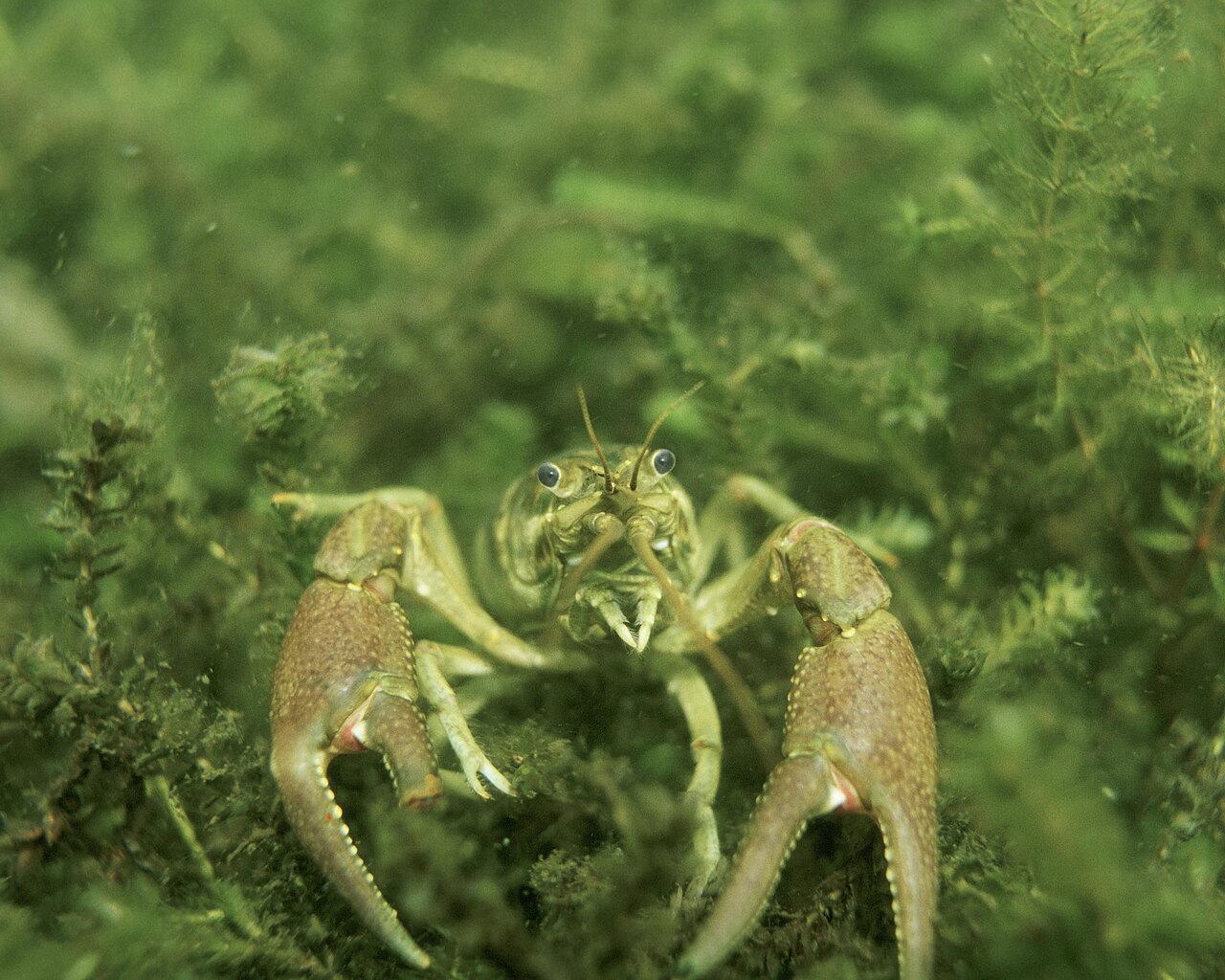
This reference uses the specific documents linked in the article and listed below. Check their scope, publication dates and the statements they support.
Host origin affects risk but does not identify infection
A. astaci is an oomycete, or water mould, rather than a true fungus. It can invade the crayfish’s outer tissues and cause severe disease in susceptible hosts. The consequences for native populations and farmed stock can be substantial.
North American species such as signal crayfish and red swamp crawfish can act as carriers with limited signs. That does not mean every individual is infected or that a carrier can never become ill. Equally, an apparently vigorous animal from a susceptible group is not proof of freedom. Species identity and source-health evidence are both needed when assessing introductions.
Source: Crayfish plague: standard diagnostic procedure; Emergency Animal Disease Bulletin 112.
Sudden losses may be more useful than a search for spots
Unexpected deaths, abnormal daytime exposure, poor coordination or inability to right can raise concern. Discolored areas in soft tissues or the shell may occur, but visible changes are variable and not specific enough to diagnose plague.
Check immediate water conditions, oxygen and possible contamination while contacting a crayfish-health or aquatic-biosecurity service. Environmental failure can also kill many animals quickly. A mass mortality does not establish which cause is responsible, and a few survivors should not be moved away as a rescue experiment before the risk is understood.
Source: Crayfish plague; Crayfish plague: standard diagnostic procedure; Introduction to fish health management.
Wet gear can move a disease between otherwise separate waters
Crayfish movements are an obvious pathway, but associated water, nets, boots and other wet equipment can also matter. A production pond may appear isolated while routine activities connect it to another site. Fish or other materials moved with contaminated water can create additional pathways.
Keep suspect equipment and stock appropriately separated. Do not release surplus or ornamental crayfish into the wild, and do not move animals or water out of an affected site without advice. Follow the competent authority’s current biosecurity guidance rather than improvise a short rinse and assume all risk has been removed.
Source: Crayfish plague; Emergency Animal Disease Bulletin 112; Crayfish plague (Aphanomyces astaci) surveillance.
Confirmation may involve affected animals and environmental evidence
The diagnostic service can test suitable crayfish material and assess lesions. Environmental DNA methods are also used in surveillance programs. A positive water signal and a demonstrated infection in an individual answer different questions and should be interpreted in their sampling context.
Norway’s current program uses eDNA for infection monitoring, reducing reliance on live susceptible animals as indicators. A farm should not deliberately expose healthy crayfish to test whether a pond is dangerous. Arrange the appropriate investigation with a specialist, including the limitations of negative results when exposure is intermittent or uneven.
Source: Crayfish plague (Aphanomyces astaci) surveillance; Crayfish plague: standard diagnostic procedure.
There is no dependable crop-level treatment to rely on
A suspected outbreak needs containment and professional assessment rather than an improvised antifungal bath. Products described for fish or aquarium invertebrates do not establish efficacy or safety for an infected crayfish crop. Repeated handling can add injury to already weakened animals.
Maintain suitable life-support while the health team considers welfare, affected-stock decisions and the connected water system. Severely compromised animals require humane management. Removing visible carcasses alone cannot certify that surviving crayfish, equipment or the water supply are safe for another site.
Source: Crayfish plague: standard diagnostic procedure; Crayfish plague; Introduction to fish health management.
Restocking requires more than a quiet period
An absence of new deaths does not necessarily establish freedom, particularly where carrier crayfish remain. Before restocking, review source stock, water connections, possible wild carriers and the authority’s requirements for the site.
Protection of farm stock and native crayfish should be considered together. Introducing a different species to replace losses can create ecological and disease problems rather than solve them. Current surveillance evidence is more informative than a historic regional absence claim, and any freedom assessment should describe what population and time period it actually supports.
Source: Crayfish plague (Aphanomyces astaci) surveillance; Emergency Animal Disease Bulletin 112; Crayfish plague.
Practical questions
Can a healthy-looking signal crayfish carry plague?
Yes. Some North American crayfish can carry infection without obvious signs.
Is a brown shell patch diagnostic?
No. Shell injury and other problems can look similar.
Should I test the pond with healthy crayfish?
No. Do not deliberately expose animals; ask about appropriate laboratory and environmental assessment.
Related animal-health reading
Cite this reference
LivestockDefense. “Crayfish plague: Aphanomyces astaci, silent carriers and protecting freshwater stock.” Updated 2026-11-02. https://livestockdefense.com/threats/crayfish-plague/
Add the date you accessed the page. This identifies the current reference; keep a permitted saved copy if your work depends on its exact wording. A citation alone does not establish support for a claim.
How to cite a page and its revision ↗Sources & boundaries
Read the evidence in context.
These documents support the statements identified in this reference. Check their scope and dates when deciding whether they answer your question.
- University of Florida IFAS Extension: Introduction to fish health management
Source update: Not provided. Most recent check: 2026-11-02.
Clinical/environmental differential assessment, skin injury and early professional diagnosis; no laboratory or chemical-treatment procedures.
- New Zealand Ministry for Primary Industries: Crayfish plague
Source update: Not provided. Most recent check: 2026-11-02.
Clinical urgency, laboratory confirmation and wet-equipment/stock introduction risk, not universal susceptibility or specimen-handling protocols.
- Norwegian Veterinary Institute: Crayfish plague (Aphanomyces astaci) surveillance
Source update: 2026-10-01. Most recent check: 2026-11-02.
Current eDNA surveillance and animal-welfare rationale; no bait-sentinel deliberate exposure or fixed historical watercourse totals.
- Australian Government Department of Agriculture: Crayfish plague: standard diagnostic procedure
Source update: Not provided. Most recent check: 2026-11-02.
High-level signs/agent/diagnostic limits only; no laboratory, propagation or experimental-infection procedures.
- Australian Government Department of Agriculture: Emergency Animal Disease Bulletin 112
Source update: Not provided. Most recent check: 2026-11-02.
American crayfish can be asymptomatic carriers; no claim that all individuals are infected or absolutely resistant.