
This reference uses the specific documents linked in the article and listed below. Check their scope, publication dates and the statements they support.
Why the names mud fever and scratches do not identify a cause
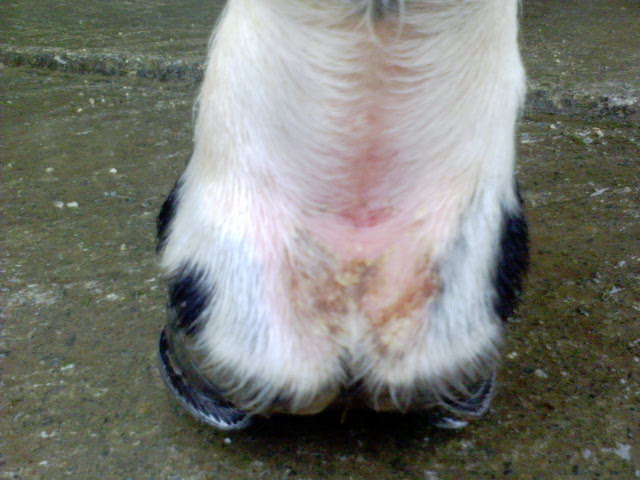
Pastern skin can become red, crusted, weeping, eroded or thickened in response to several different processes. Calling the condition mud fever describes a familiar setting but does not prove that mud, a particular bacterium or a fungus initiated it. Persistent wetness can damage the barrier and allow secondary infection without being the only disease present.
This distinction is practical. An antimicrobial cannot correct a contact irritant that is reapplied every day. A dry bed cannot eliminate a confirmed mite infestation. A short course for infection cannot reverse underlying chronic progressive lymphedema. The treatment needs to match the mechanism responsible in that horse.
Source: Pastern dermatitis (scratches); Dermatological, wounds and feet disorders: equine guidelines.
Recognize when a local skin problem has become urgent
Mild early lesions can be small and easy to overlook, especially beneath feathering. Increasing heat, swelling, pain, discharge or lameness changes the priority. Severe pain, a rapidly enlarging leg or a horse that appears ill warrants prompt veterinary assessment rather than another trial of an over-the-counter cream.
Do not force a painful horse to move repeatedly to demonstrate lameness. Arrange a safe clean area and obtain advice about appropriate handling. Deeper infection or another source of limb pain may coexist with the visible skin lesions, so the skin's appearance alone cannot establish the extent of disease.
Source: Scratches: a skin problem in horses; Pastern dermatitis (scratches); Dermatological, wounds and feet disorders: equine guidelines.
Distribution and exposure help separate the possibilities
The veterinarian considers whether one or several legs are involved, whether white and dark skin differ, how the lesions began and which treatments have contacted them. Moisture trapped by boots, wraps or feathering can perpetuate damage. White limbs may also need assessment for sunlight-associated vascular or photosensitivity problems.
Itching and stamping in a heavily feathered horse raise the question of Chorioptes mites. Firm folds and persistent swelling raise a different question about lymphatic disease. These are reasons to examine beneath the hair, not proof that every feathered horse has the same diagnosis. Several mechanisms may contribute in one patient.
Source: Pastern dermatitis (scratches); Mange in horses; Chronic progressive lymphedema.
Testing is selected to answer a clinical question
Examination may be supported by cytology, appropriate cultures, mite assessment or biopsy, depending on the suspected process. Recurrent or treatment-resistant disease often deserves more than repeating a previous prescription. A superficial organism can represent secondary colonization, while deeper tissue or other tests may be needed for a different question.
Tell the veterinarian what topical products have already been applied because they can alter the skin and interpretation. A negative finding for one parasite or organism does not establish every alternative is absent. The aim is a defensible explanation for persistent injury and a care plan that the horse can tolerate.
Source: Pastern dermatitis (scratches); Dermatological, wounds and feet disorders: equine guidelines.
Gentle skin care differs from repeatedly attacking the crusts
Keeping the area appropriately clean and dry is useful, but frequent aggressive washing, abrasive scrubbing or forceful crust removal can further damage sensitive skin. Painful clipping or handling may need veterinary assistance. Avoid adding multiple unprescribed products at once, especially when irritation worsens after application.
The clinician may prescribe treatment for secondary infection, inflammation or a confirmed parasite and recommend a specific approach to hair and dressings. Boots or wraps that trap moisture are not automatically protective. Choose a plan that improves the skin barrier and comfort rather than one that only changes the surface color.
Source: Pastern dermatitis (scratches); Dermatological, wounds and feet disorders: equine guidelines; Scratches: a skin problem in horses.
Chronic swelling needs its own diagnosis and prognosis
A draft horse with persistent thickened lower limbs may have chronic progressive lymphedema. Secondary dermatitis can flare repeatedly because the underlying lymphatic function remains abnormal. Treating each flare as a fresh simple mud infection misses that continuing disease.
Likewise, marked acute swelling can involve cellulitis or lymphangitis rather than uncomplicated dermatitis. A veterinarian should assess the whole limb and the horse's general condition. Prognosis depends on the cause, depth, chronic changes and the ability to prevent repeated skin injury, not on the familiar name used by the yard.
Source: Chronic progressive lymphedema; Chronic progressive lymphedema: Horse Report spring 2022; Pastern dermatitis (scratches).
Prevent repeated damage in the places the horse actually uses
Provide clean dry resting areas and reduce prolonged exposure to mud or wet bedding. Dry the lower limbs appropriately after washing, check under boots and wraps and keep feathered skin accessible for examination. Any clipping plan should account for the horse's comfort and skin condition.
Prevention also needs the identified cause: appropriate mite control, avoidance of a contact product, sunlight management or long-term lymphatic care may be required. Successful recovery is comfortable intact skin and improved movement, with recurrences prompting reassessment rather than an assumption that the same remedy is always needed.
Source: Pastern dermatitis (scratches); Scratches: a skin problem in horses; Dermatological, wounds and feet disorders: equine guidelines.
Practical questions
Is scratches always a bacterial infection?
No. It is a descriptive syndrome, and bacteria may be secondary to another process.
Should I scrub until every crust comes off?
Avoid forceful repeated removal. Painful or persistent lesions need a plan that protects the skin barrier.
Is this the same as chronic progressive lymphedema?
No. CPL is an underlying lymphatic disorder that can produce repeated secondary pastern dermatitis.
Related animal-health reading
Cite this reference
LivestockDefense. “Pastern dermatitis in horses: scratches, underlying causes and effective care.” Updated 2026-11-02. https://livestockdefense.com/threats/equine-pastern-dermatitis/
Add the date you accessed the page. This identifies the current reference; keep a permitted saved copy if your work depends on its exact wording. A citation alone does not establish support for a claim.
How to cite a page and its revision ↗Sources & boundaries
Read the evidence in context.
These documents support the statements identified in this reference. Check their scope and dates when deciding whether they answer your question.
- UC Davis Center for Equine Health: Pastern dermatitis (scratches)
Source update: 2022-04-14. Most recent check: 2026-11-02.
Condition-specific mechanisms, signs, diagnostic limitations and care principles attributed to this document; no drug dosages or invasive procedures reproduced.
- University of Minnesota Extension: Scratches: a skin problem in horses
Source update: Not provided. Most recent check: 2026-11-02.
Condition-specific mechanisms, signs, diagnostic limitations and care principles attributed to this document; no drug dosages or invasive procedures reproduced.
- University of Melbourne Australian Veterinary Prescribing Guidelines: Dermatological, wounds and feet disorders: equine guidelines
Source update: 2025. Most recent check: 2026-11-02.
Condition-specific diagnostic reasoning, stewardship and care principles; no antimicrobial dose, invasive procedure or blanket international prescribing permission reproduced.
- UC Davis Center for Equine Health: Chronic progressive lymphedema
Source update: 2019-07-05. Most recent check: 2026-11-02.
Condition-specific mechanisms, signs, diagnostic limitations and care principles attributed to this document; no drug dosages or invasive procedures reproduced.
- UC Davis Center for Equine Health: Chronic progressive lymphedema: Horse Report spring 2022
Source update: 2022. Most recent check: 2026-11-02.
Distinction between underlying lymphatic disease and secondary recurrent pastern dermatitis; professional supportive care context, not bandaging or massage instructions.
- Merck Veterinary Manual: Mange in horses
Source update: 2024-09. Most recent check: 2026-11-02.
Mite identity, lesions, diagnostic limitations and treatment categories; historical label claims, doses and repeat intervals not reproduced.