
This reference uses the specific documents linked in the article and listed below. Check their scope, publication dates and the statements they support.
The neurologic form is mainly a brainstem disease
The brainstem coordinates important functions involving the face, balance and swallowing. Listeria monocytogenes can cause an ascending, often asymmetric infection in this region. Damage to cranial nerve pathways explains why one side of the face or head may be affected more than the other. Merck’s current ruminant clinical account.
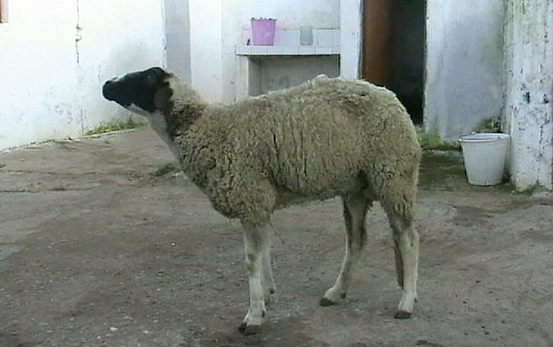
The nickname “circling disease” captures one possible sign but can be misleading. A sheep or cow need not circle continuously to have listeriosis. Facial droop, reduced sensation, abnormal eyelid function, salivation or difficulty handling feed may be more useful early clues. A calf with a head tilt may instead have middle-ear disease, so location and the rest of the examination still matter.
Not every case involves the brain
Listeria can also infect the placenta and fetus, causing abortion, stillbirth or neonatal loss, and can cause septicemia in susceptible animals. A dam may abort without previously showing conspicuous illness. Neurologic and reproductive presentations do not need to appear together in one herd before listeriosis is considered. Separate reproductive and neurologic forms.
This distinction changes the investigation. A neurologic adult, an aborting ewe and a septic newborn need different clinical and diagnostic priorities. A familiar silage history does not make all three the same case, and a lack of circling does not exclude a reproductive form.
Feed exposure is important without being the only route
Listeria organisms occur in the environment, and preserved-forage problems are a recognized context for ruminant disease. Poorly conserved or spoiled silage and soil or manure contamination deserve attention. NADIS’s sheep guidance; Iowa State’s broader disease factsheet.
However, listeriosis is not confined to farms feeding one silage type. The complete feeding and environmental history matters. A healthy-looking bale is not proof of microbiological safety, while visible mold does not identify Listeria by appearance. Suspect spoiled forage should not simply be diverted to another species on the assumption that those animals are immune.
When reduced appetite becomes an emergency
An animal that drops feed, drools unusually, has a facial asymmetry, tilts its head or behaves abnormally needs prompt veterinary examination. Inability to swallow, marked imbalance, recumbency or deterioration makes the case particularly urgent. The clinical review emphasizes better outcomes with early treatment. Urgency and prognosis.
Keep the animal quiet and protected from falling, trampling or getting trapped. Do not force oral fluids into one with an ineffective swallow. A hungry-looking animal can still be unable to move food safely past the throat, and aspiration would add another serious problem.
Diagnostic reasoning: asymmetry helps but does not prove
A veterinarian assesses cranial nerve function, balance, awareness, swallowing and systemic illness. The asymmetric brainstem pattern can make listeriosis more likely than some generalized metabolic disorders, but other infections, trauma, ear disease and neurologic conditions remain possible. Polioencephalomalacia and pregnancy toxemia are important comparisons in suitable animals.
Appropriate testing or pathology can support confirmation. In abortion cases, interpretation needs to establish whether placental or fetal disease is compatible, rather than treating detection of an organism in a nonspecific setting as the entire explanation. The laboratory and veterinarian choose suitable diagnostic material and safe submission arrangements; owners should not attempt a diagnostic dissection or organism culture.
Possible rabies or another locally important neurologic disease changes handling and reporting decisions. Do not put unprotected hands into an animal’s mouth to test swallowing. The clinical examination should be carried out with the differential risks in mind.
What treatment involves
Veterinary treatment generally uses an appropriate antimicrobial plan and supportive care. Selection needs to account for the nervous-system disease, severity, food-animal rules and possible resistance, rather than assuming that any routine pneumonia product will suffice. Treatment discussion.
Care may also address dehydration, pain, safe nutrition and eye protection when facial nerve dysfunction prevents normal blinking. A cow standing up is not necessarily able to swallow or protect its eye normally. Ongoing assessment of these functions is part of useful recovery.
Severe neurologic impairment and inability to rise worsen the outlook. If the animal cannot be stabilized or maintained comfortably, discuss a humane endpoint. Repeatedly administering an ineffective treatment while swallowing and mobility deteriorate can prolong suffering without a realistic recovery plan.
Abortion and human-health precautions
Listeriosis has zoonotic and food-safety significance. Keep unnecessary people away from abortion materials and prevent access by other animals while veterinary advice is obtained. Use protective clothing and gloves for necessary contact, and follow safe disposal and cleaning instructions appropriate to the farm and jurisdiction. Zoonotic and reproductive context.
Pregnant or immunocompromised people should avoid potentially infectious reproductive material and discuss relevant exposure with a healthcare professional. Do not use raw milk from a suspect animal as a food-safety workaround or feed an aborted fetus to dogs. Clinical recovery of an animal is not, by itself, a clearance for milk use.
Prevention that reaches the feeding face
Reduce soil and manure contamination during forage production and feed-out, maintain appropriate preservation and remove spoiled feed and refusals. Keep feeding equipment and troughs clean and examine the actual material reaching the animals. Forage hygiene and preservation. Avoid assuming that changing one bale instantly prevents every case after an earlier exposure.
The cattle hub, sheep hub and goat hub provide wider feeding and health context. A neurologic case deserves individual treatment and a feed-risk review; an abortion pattern deserves a reproductive investigation as well.
Does every animal that circles have listeriosis?
No. Circling is a neurologic sign with several causes. Its direction and associated facial, eye, balance and swallowing findings help the veterinarian localize the problem and choose tests and treatment.
Can listeriosis cause abortion without neurologic cases?
Yes. Reproductive and neurologic disease are separate recognized presentations and often do not occur simultaneously. Investigate the losses even when the adult flock walks normally.
Cite this reference
LivestockDefense. “Listeriosis in cattle, sheep and goats: circling, swallowing problems and abortion.” Updated 2026-11-02. https://livestockdefense.com/threats/listeriosis-in-ruminants/
Add the date you accessed the page. This identifies the current reference; keep a permitted saved copy if your work depends on its exact wording. A citation alone does not establish support for a claim.
How to cite a page and its revision ↗Sources & boundaries
Read the evidence in context.
These documents support the statements identified in this reference. Check their scope and dates when deciding whether they answer your question.
- Merck Veterinary Manual: Listeriosis in animals
Source update: 2026-08. Most recent check: 2026-11-02.
Asymmetric ruminant brainstem signs, abortion/sepsis forms, early antimicrobial/supportive care and diagnostic context. No bacterial culture, propagation, tissue-collection procedure or drug dose reproduced.
- Iowa State University Center for Food Security and Public Health: Listeriosis
Source update: 2019-05. Most recent check: 2026-11-02.
Environmental/feed and reproductive disease context, zoonotic precautions and food safety; no pathogen growth conditions, infectious dose or laboratory methods reproduced.
- NADIS: Nervous diseases in sheep: listeriosis
Source update: 2019. Most recent check: 2026-11-02.
Sheep neurologic presentation, preserved-forage association and soil/manure contamination prevention. Historical suggestion to divert spoiled silage to cattle is explicitly not adopted; suspect spoiled feed is not reassigned to other stock.