
This reference uses the specific documents linked in the article and listed below. Check their scope, publication dates and the statements they support.
Animal at a glance
| Topic | Overview |
|---|---|
| Animal group | Terrestrial gastropod molluscs; food species must be identified |
| Production roles | Live food snails, processed products and breeding stock |
| Life stages | Breeding snail, eggs, hatchlings and growing stock |
Identify the snail before building the pen
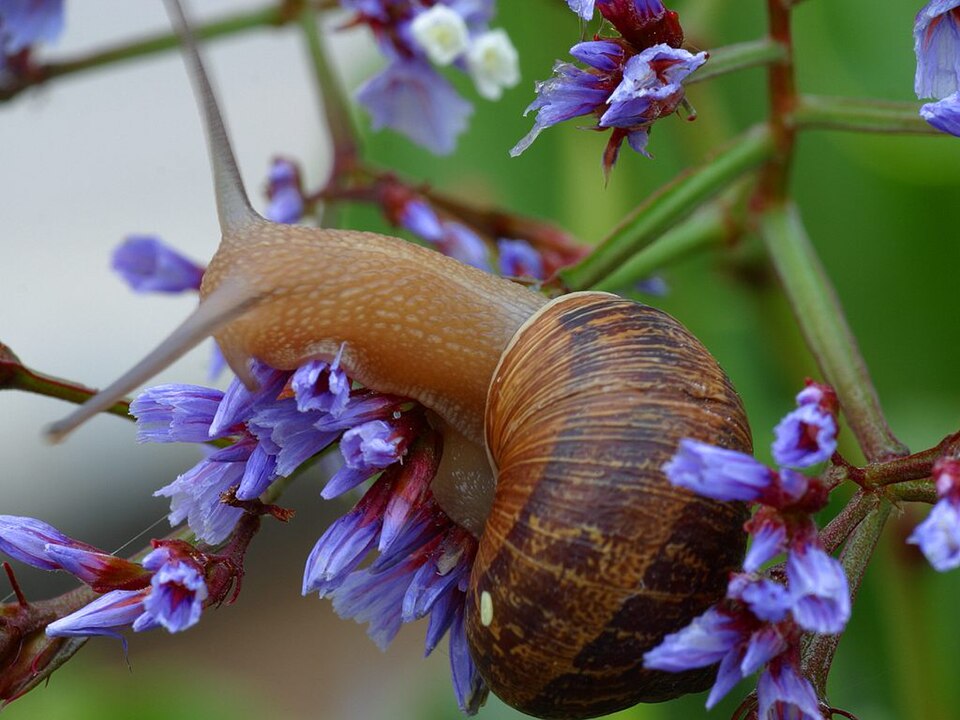
Edible land snails include different species with different climate and production requirements. A photograph of Cornu aspersum is not a universal model for giant African snails or every other snail used as food. Know the actual stock and whether keeping, moving and breeding it is allowed locally.
The USDA National Agricultural Library highlights containment and invasive-species concerns. Its US permitting examples are jurisdiction-specific, but the underlying planning question applies broadly: can the farm keep the animals and their eggs from escaping into the surrounding environment?
Moisture, drainage and shade must work together
Snails need an environment that supports normal activity without drying them excessively. That is not the same as a waterlogged pen. Provide appropriate shade, suitable substrate and drainage; avoid constant pools, compacted wet corners or a sealed enclosure with stale air.
Assess conditions where the snails actually rest and feed. A misting system can leave one area dry and another saturated. Check its distribution rather than increasing the runtime whenever activity falls. Temperature, species, food, crowding and reproductive stage can all affect activity, so quiet snails should not automatically trigger heavier watering.
Containment should be designed into walls, covers, doors and drains. Check the enclosure after cleaning and maintenance, when openings are most likely to be left unsecured. Young snails and eggs require attention as well as visible adults. Do not release surplus stock or discard substrate outdoors where live stages could remain.
Feed quality matters more than a large pile of greens
Provide known suitable plant material or a properly formulated snail diet, according to the species and system. Keep pesticides, mold and spoiled leftovers out of the pen. Wash or prepare ingredients as appropriate to their source; a plant being edible to people does not automatically make every part suitable as snail feed.
Shell growth requires suitable calcium, but a calcium source alone does not create a balanced ration. The FAO snail husbandry manual discusses feeding, enclosure management and separate care for life stages. Use its principles with local technical advice instead of copying a recipe into a different species or climate.
Place feed where it can be replaced without trampling the animals. Remove uneaten material before it decays and inspect hidden areas beneath feeding surfaces. If snails cluster at one feeding point, assess access and the rest of the pen rather than simply adding more feed to the same spot.
Separate the needs of breeders, hatchlings and growers
Breeders need conditions appropriate for egg laying and recovery. Hatchlings need protection from unsuitable openings, predation and competition. Growers need usable space and feeding access as their size increases. A pen that contains all stages may make it difficult to meet these requirements or notice poor survival early.
Do not expand production solely from egg counts. Plan grow-out capacity, mortality management, containment and the market for the mature product. Keep newly purchased stock separate while assessed, and avoid introducing wild snails to replenish breeders: they can change both disease exposure and the species present.
Shell damage and illness need investigation
Broken or weak shells, unusual mortality, persistent inactivity despite suitable conditions or failure to grow merit an assessment of diet, moisture, temperature, crowding and possible disease. Do not spray an enclosure with livestock medicines or household chemicals on the assumption that snails will tolerate them.
Harvest and processing need a verified food-safety process. Feeding snails clean plants or holding them without feed does not by itself establish that they are safe for people to eat. This husbandry page does not provide a processing or cooking validation.
Can snails be raised in any damp garden corner?
No. Species, contamination, predators, drainage and containment all matter. An uncontained garden patch can create an escape and invasive-species problem.
Is calcium enough to prevent shell problems?
No. Calcium is one part of care; diet balance, growth stage and environmental conditions also need assessment.
Continue reading
Field guides for this animal
Browse all Edible land snails field guides for husbandry advice, health explanations and practical farm routines.
Cite this reference
LivestockDefense. “Farmed edible land snails: feed, moisture, shells and containment.” Updated 2026-11-02. https://livestockdefense.com/animals/edible-snails/
Add the date you accessed the page. This identifies the current reference; keep a permitted saved copy if your work depends on its exact wording. A citation alone does not establish support for a claim.
How to cite a page and its revision ↗Sources & boundaries
Read the evidence in context.
These documents support the statements identified in this reference. Check their scope and dates when deciding whether they answer your question.
- FAO: Improved snails farming
Source update: Not provided. Most recent check: 2026-11-02.
Bounded species biology, feeding context and production or husbandry statements attributed to this document in the animal overview sections. No numerical feeding, medication, restraint or breeding protocol reproduced.
- USDA National Agricultural Library: Snail farming
Source update: Not provided. Most recent check: 2026-11-02.
Containment, invasive-species concerns and official permitting resources; US examples are jurisdiction-specific.