
This reference uses the specific documents linked in the article and listed below. Check their scope, publication dates and the statements they support.
Animal at a glance
| Topic | Overview |
|---|---|
| Animal group | Regional bovine livestock also called gayal |
| Production roles | Food production and culturally important breeding, ownership and exchange roles |
| Life stages | Identified breeding animals, calves and managed growing groups |
Respect the animal and the production setting
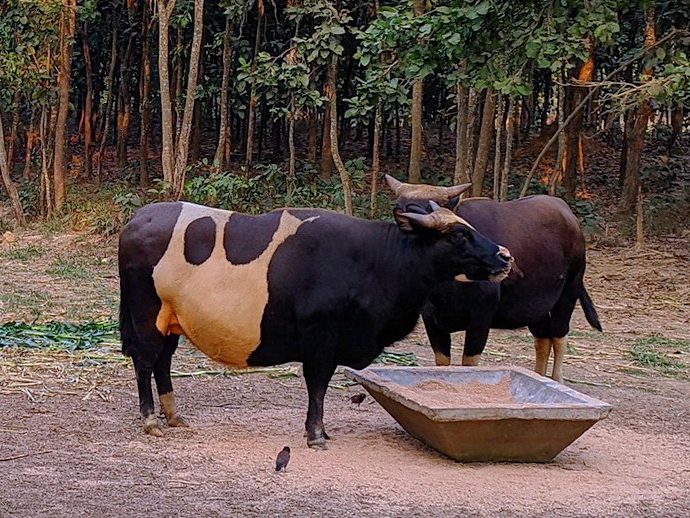
Mithun, commonly named Bos frontalis, have cultural as well as food-production importance. Their traditional forest-based husbandry differs from a small enclosed cattle feedlot. ICAR's Porba case study describes a locally developed semi-intensive system using shelter, managed grazing, calf care and coordinated veterinary support.
That example shows the value of improving several parts of care together. It does not establish a universal stocking rate or vaccination calendar. A farm in another region should first assess its land, feed plants, predators, climate and access to veterinary services.
Browse supply must work through the lean season
Mithun use browse and other vegetation, but the presence of trees is not proof of an adequate ration. Identify accessible, suitable species and plan for the time when preferred foliage becomes scarce. Keep toxic, chemically treated or unfamiliar plants out of supplementary feeding until their suitability is established.
ICAR's husbandry article discusses mineral supply and the need for additional feed during lean periods. The practical task is to match supplementation to the actual forage and animal stage, not to copy a concentrate quantity from an unrelated herd. Growing animals, late-pregnant females and lactating females should not be expected to maintain performance on the same poor-quality feed as a nonproductive adult.
Place feed and mineral access where smaller animals can use them safely. Offer clean drinking water rather than assuming forest vegetation supplies enough moisture. If the herd waits at an empty trough or only dominant adults approach the supplement, the intended nutritional plan is not reaching every animal.
Make shelter and grazing compatible
Night shelter can improve opportunities to protect calves, inspect animals and provide supplementary feed. It needs a safe approach, sound fencing, dry resting space and ventilation. Muddy entrances or overcrowded shelters can introduce foot, hygiene and competition problems even when the roof is good.
Where grazing is rotated, allow plants time to recover and inspect whether all areas provide useful feed. Moving animals according to a fixed calendar does not guarantee sufficient regrowth. The decision should reflect local rainfall, ground condition and what the animals can actually eat.
Calf survival and breeding deserve deliberate attention
Prepare a protected calving and early-life care arrangement. A newborn that cannot nurse, a female that strains without progress or a calf injured during group movement requires prompt professional attention. Calves need access to their dams and later to appropriate feed without being forced through crowded adult feeding points.
Breeding management should preserve genetic diversity and avoid repeatedly using closely related animals. ICAR describes difficulties in observing estrus and the need for species-informed selection. An absence of obvious heat behavior does not by itself prove infertility. Seek reproductive assessment rather than trying unprescribed hormones or transferring a dairy-cow synchronization program unchanged.
Prevent exposure without losing practical access
New arrivals should have a separate assessment period and a veterinary plan appropriate to local risks. Shared grazing and community movements make coordinated prevention important. Mouth lesions, drooling, lameness, sudden illness or unusual mortality require advice from the responsible animal-health service; do not move an affected animal through neighboring herds while deciding what it might have.
Keep routine handling calm and use facilities designed for large bovines. Familiarity with a tame individual does not make every adult safe to restrain. Prepare an escape route for handlers and avoid working alone in a tight space with a distressed animal.
Can mithun be managed exactly like domestic cattle?
Some ruminant principles are shared, but browse use, breeding behavior, social setting and facility design need species-specific planning.
Does a semi-intensive system eliminate the need for grazing?
No. It is a coordinated system of forage access, shelter, supplementary nutrition and health care. Restricting movement without replacing the lost feed opportunity can make condition worse.
Continue reading
Cite this reference
LivestockDefense. “Mithun / gayal: browse, shelter, calf care and breeding.” Updated 2026-11-02. https://livestockdefense.com/animals/mithun/
Add the date you accessed the page. This identifies the current reference; keep a permitted saved copy if your work depends on its exact wording. A citation alone does not establish support for a claim.
How to cite a page and its revision ↗Sources & boundaries
Read the evidence in context.
These documents support the statements identified in this reference. Check their scope and dates when deciding whether they answer your question.
- Indian Council of Agricultural Research: Semi-intensive mithun farming in Porba, Nagaland
Source update: Not provided. Most recent check: 2026-11-02.
Bounded species biology, feeding context and production or husbandry statements attributed to this document in the animal overview sections. No numerical feeding, medication, restraint or breeding protocol reproduced.
- ICAR / Indian Farming: Mithun: scientific rearing and conservation
Source update: Not provided. Most recent check: 2026-11-02.
Browse-based feeding, seasonal supplementation, reproduction and semi-intensive care of mithun; no fixed ration or medical schedule reproduced.