
This reference uses the specific documents linked in the article and listed below. Check their scope, publication dates and the statements they support.
Papillomas vary in shape and tissue involvement
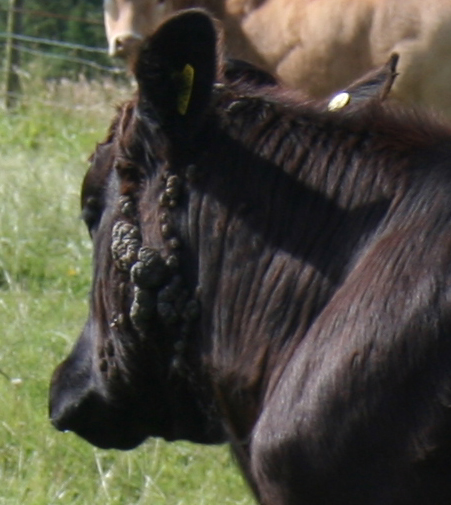
A wart may be flat and broad-based, stalked or rough and cauliflower-like. Fibropapillomas contain a more substantial connective-tissue component as well as altered surface tissue. Several bovine papillomaviruses are associated with different lesion patterns, so “a wart virus” does not describe one identical growth everywhere on the cow.
Merck’s papillomatosis section describes head, neck and shoulder lesions and their variable course. The visible surface is useful for suspicion but does not establish the exact virus type or exclude another tumor.
Why young cattle are commonly affected
Young animals are often more susceptible to visible warts as immunity develops. Infection enters through damaged skin and may be spread during contact or via contaminated equipment. A growth can appear well after the original exposure, making the most recent handling event an unreliable explanation by itself.
The Queensland cattle-wart guide describes young-animal susceptibility and skin-abrasion entry. Look at repeated sources of rubbing or injury and at shared handling equipment when several young cattle are affected. The aim is to reduce avoidable spread and damage, not to create a new wound while trying to remove every small wart.
Older cattle can also have persistent lesions. Age alone is not a reason to dismiss a growth or to conclude that it must be cancer. The animal's general health, lesion location and change over time need assessment together.
Location can matter more than size
A large wart on an unobtrusive skin site may cause little trouble, while a small lesion at a teat opening can interfere with milk flow or the milking-machine seal. Merck’s teat-skin chapter distinguishes smooth nodules from frond-like lesions that cause practical milking problems.
Genital fibropapillomas can interfere with service or become traumatized and infected. NADIS describes these problems in young bulls. A bull attempting to mate is not proof that it can achieve normal service; discharge, bleeding or failed breeding deserves examination.
Lesions near an eye, mouth or other functional opening also need individual assessment. Do not wait for an otherwise small growth to become huge if it is already preventing normal feeding, sight or milking.
When an apparently ordinary wart needs attention
Repeated bleeding, discharge, pain, rapid change or persistent ulceration can indicate trauma, secondary infection or a different diagnosis. Numerous lesions with declining condition merit a broader health assessment. A mass with an unusual location or appearance may require biopsy.
Not every fleshy foot lesion is papillomavirus. Digital dermatitis and interdigital hyperplasia have different mechanisms despite names such as “hairy heel wart” or a wart-like appearance. Lumpy skin disease is another distinct condition requiring a different response when its clinical context fits.
Do not squeeze, cut or tie off an uncertain mass to identify it. That can cause hemorrhage, tissue damage or infection while obscuring what the veterinarian needs to assess.
Observation is a clinical choice, not neglect
Many uncomplicated skin warts regress as the animal's immune response develops. Duration varies considerably, so disappearance cannot be promised within one fixed number of weeks. When a lesion is not painful or interfering with function, the veterinarian may recommend observation and protection from trauma.
The useful endpoint is normal function and an acceptable clinical course. If a wart repeatedly catches on equipment or bleeds, the balance changes. The treatment decision should respond to that actual harm rather than the owner's understandable dislike of its appearance alone.
Treatment has limits and needs a defined purpose
Selected lesions may need professional removal or other veterinary treatment. Site, growth stage and the possibility of recurrence influence the plan. Merck notes uncertainty about comparative treatment efficacy and variation in the natural course, making it difficult to credit every spontaneous regression to a recently applied remedy.
Veterinary vaccine options, where available and appropriate, require professional assessment; they are not a reason to prepare or inject wart material at home. Product authorization differs geographically. Avoid caustic household applications, especially on teat openings, eyelids or mucous membranes.
Reduce preventable contact and injury
Maintain clean handling equipment and reduce repeated trauma around affected sites. In a group outbreak, review which instruments or surfaces contact several animals. Do not deliberately manipulate or remove warts during routine handling without an agreed care plan.
The cattle hub provides the wider husbandry context. Where teat lesions are painful or ulcerated rather than typical warts, herpes mammillitis and other causes need separate assessment.
Does every wart eventually become cancer?
No. Ordinary cutaneous papillomatosis is usually benign and often self-limiting. Particular virus–tissue–environment associations are different from saying that every skin wart is precancerous. Persistent or atypical lesions should be examined on their own evidence.
Cite this reference
LivestockDefense. “Warts in cattle: bovine papillomatosis and when treatment helps.” Updated 2026-11-02. https://livestockdefense.com/threats/bovine-papillomatosis/
Add the date you accessed the page. This identifies the current reference; keep a permitted saved copy if your work depends on its exact wording. A citation alone does not establish support for a claim.
How to cite a page and its revision ↗Sources & boundaries
Read the evidence in context.
These documents support the statements identified in this reference. Check their scope and dates when deciding whether they answer your question.
- Merck Veterinary Manual: Diseases of Bovine Teats and Skin
Source update: 2026-02. Most recent check: 2026-10-30.
Document scope and recorded checks
Teat skin conditions have multiple causes; wet-skin cold exposure and milking-equipment factors are relevant contexts. No product selection, examination or intervention supplied. Several conditions affect teat skin; pseudocowpox and cowpox are distinct entities and have human-health relevance. No image diagnosis, lesion handling, virus isolation or treatment procedure supplied.
Entries retain the date and scope of each recorded inspection.
- 2026-10-30 — Several conditions affect teat skin; pseudocowpox and cowpox are distinct entities and have human-health relevance. No image diagnosis, lesion handling, virus isolation or treatment procedure supplied.
Exact publisher page or indexed publisher text inspected for the bounded facts identified; no independent veterinary review implied
- 2026-10-29 — Teat skin conditions have multiple causes; wet-skin cold exposure and milking-equipment factors are relevant contexts. No product selection, examination or intervention supplied.
Exact publisher page or indexed publisher text inspected for the bounded facts identified; no independent veterinary review implied
- 2026-10-30 — Several conditions affect teat skin; pseudocowpox and cowpox are distinct entities and have human-health relevance. No image diagnosis, lesion handling, virus isolation or treatment procedure supplied.
- Merck Veterinary Manual: Epidermal and hair follicle tumors in animals: papillomatosis
Source update: Not provided. Most recent check: 2026-11-02.
Cattle wart distribution and variable duration, fibropapilloma distinction, functional problems and uncertain comparative treatment efficacy. Other-species lesions and experimental inoculation protocols not reproduced.
- Queensland Government: Warts on cattle
Source update: Not provided. Most recent check: 2026-11-02.
Young-cattle susceptibility, abrasion-associated entry, variable wart form, bleeding/secondary infection and spontaneous regression. Historical vaccine registration and home ligation directions not generalized.
- NADIS: Lymphatic and other tumours in cattle: papillomatosis
Source update: 2011. Most recent check: 2026-11-02.
Papilloma appearance, young-animal distribution, equipment/contact transmission and genital interference. Obsolete count of BPV types and autogenous-vaccine manufacturing description not adopted.