
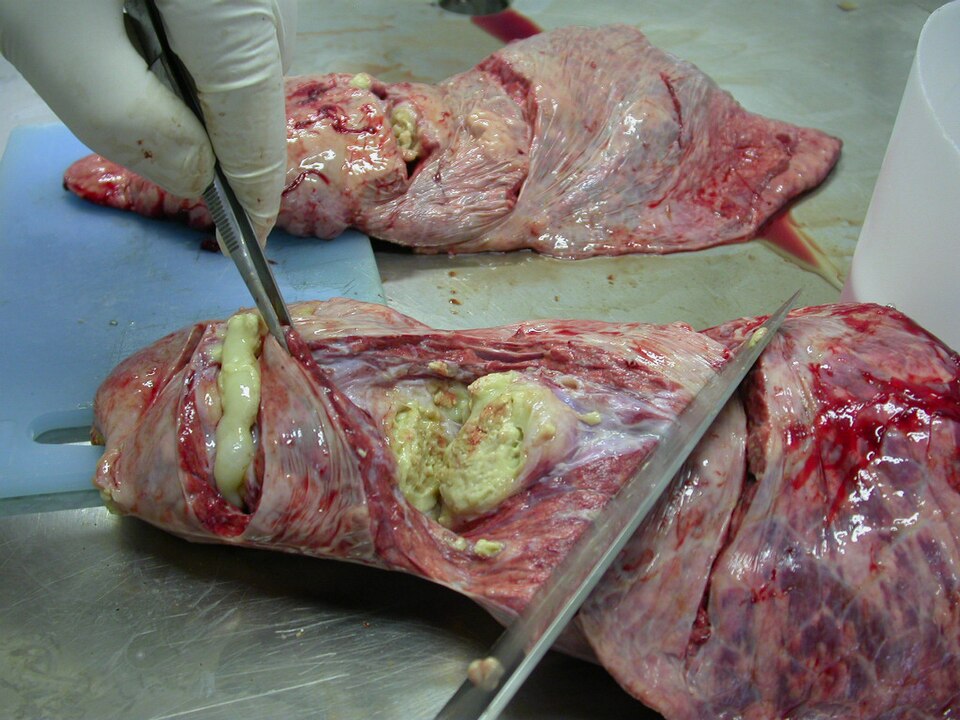
This reference uses the specific documents linked in the article and listed below. Check their scope, publication dates and the statements they support.
A normal-looking cow can still be important
APHIS's cattle reference explains that infected cattle are usually asymptomatic. Visible clinical disease can be advanced, while many detections arise through surveillance. This means that healthy appearance at purchase or a period of apparently normal milk production cannot establish a tuberculosis-free animal.
The uploaded profile describes chronic weight loss, weakness and later respiratory findings. Those observations justify examination but overlap other diseases. Do not use the absence of one sign as a home screening test, or make a confirmed diagnosis from a cough in an animal whose exposure and test history are unknown.
Exposure can enter with cattle or cross the wildlife interface
APHIS identifies introductions and infected wildlife among routes by which a herd can become affected. Respiratory contact and ingestion of contaminated feed or water are relevant. An investigation should examine actual animals and contact opportunities rather than assume the most visible nearby species is the source.
The APHIS wildlife programme explains how spillover can help maintain infection and expose livestock again in some settings. Its emphasis on area-specific surveillance is important: evidence about a reservoir in one region should not become a claim that every deer population carries M. bovis.
Detection uses more than one surveillance system
APHIS describes slaughter inspection as a major surveillance route, supplemented by testing for movements and during investigations. A finding identified after an animal leaves the farm may therefore be the first indication that a herd requires follow-up. That does not necessarily mean the animal showed recognizable illness before departure.
Keep identification and movement records available so officials can trace relevant contacts. Trace-back asks where an affected animal came from; tracing onward asks where exposed animals may have gone. Neither question can be answered reliably by remembering only the most recent sale or the group occupying the same pen today.
A screening result begins a pathway
Live-animal screening and confirmatory testing have distinct roles. APHIS states that a positive screen is followed by a regulatory veterinarian's confirmatory work. Owners should retain the actual classification and report rather than collapsing suspect, reactor and confirmed infection into a single informal phrase.
Ask who is responsible for the next decision and what movement controls apply while it is pending. A result requiring follow-up is not an invitation to seek repeated independent tests until one is negative. Equally, a preliminary finding should not be published as final organism identification before the investigation establishes that conclusion.
Herd control is different from treating a sick cow
APHIS states that tuberculosis is not treated in livestock. Infected-herd management may involve depopulation or an official test-and-removal programme. These are regulatory decisions made with animal-health authorities, including the consequences for linked herds and permitted movements.
Discuss welfare and essential daily work within that response. A restriction does not remove the need to feed, milk or care for animals; it changes how tasks and contacts must be managed. Agree who communicates with haulers, employees and receiving businesses so an unplanned movement does not create a new investigation problem.
Human tuberculosis needs the organism and exposure context
CDC distinguishes M. bovis from M. tuberculosis, which causes most human tuberculosis. People can acquire M. bovis through contaminated unpasteurized dairy products, relevant tissue contact or inhalation near infected animals. Pasteurization removes an important milk-associated pathway. General risk is low, but relevant occupational exposures warrant individual assessment.
Tell a healthcare professional about close work with a suspect or infected herd and any specific contact. A human clinician decides whether assessment or testing is needed. Do not substitute a cattle test result for a person's medical evaluation, or assume that lack of human symptoms immediately after contact answers the question.
Questions about bovine tuberculosis
Does the low national prevalence certify my herd?
No. Population surveillance describes a wider setting. A particular herd's status requires its own current evidence and official records.
Is cervid testing identical to cattle testing?
No. The farmed-cervid reference explains why species, approved assays and official pathways matter. Do not transfer a deer testing document onto cattle.
Can a historical negative result authorize a new movement?
Not by itself. Check the current purpose, destination requirements and animal identification with the accredited veterinarian before arranging transport.
Where does ordinary pneumonia fit?
The cattle respiratory disease reference covers a different clinical complex. Similar respiratory wording does not make the two diagnoses interchangeable.
Cite this reference
LivestockDefense. “Bovine tuberculosis: silent cattle infection and herd investigation.” Updated 2026-10-29. https://livestockdefense.com/threats/bovine-tuberculosis/
Add the date you accessed the page. This identifies the current reference; keep a permitted saved copy if your work depends on its exact wording. A citation alone does not establish support for a claim.
How to cite a page and its revision ↗Sources & boundaries
Read the evidence in context.
These documents support the statements identified in this reference. Check their scope and dates when deciding whether they answer your question.
- USDA Animal and Plant Health Inspection Service: Bovine Tuberculosis in Cattle
Source update: 2026-05-06. Most recent check: 2026-10-29.
Often asymptomatic cattle, slaughter/live surveillance, confirmatory testing and official eradication response; no current herd count transferred.
- Centers for Disease Control and Prevention: About Bovine Tuberculosis in Humans
Source update: 2024-05-20. Most recent check: 2026-10-29.
M. bovis versus M. tuberculosis, raw dairy and occupational exposure, pasteurization and medical assessment after relevant exposure.
- USDA Animal and Plant Health Inspection Service: NWDP: Bovine Tuberculosis in Wildlife
Source update: 2026-01-13. Most recent check: 2026-10-29.
Location-specific wildlife reservoir and spillover investigation, with area-specific surveillance rather than assumptions about all wildlife.