
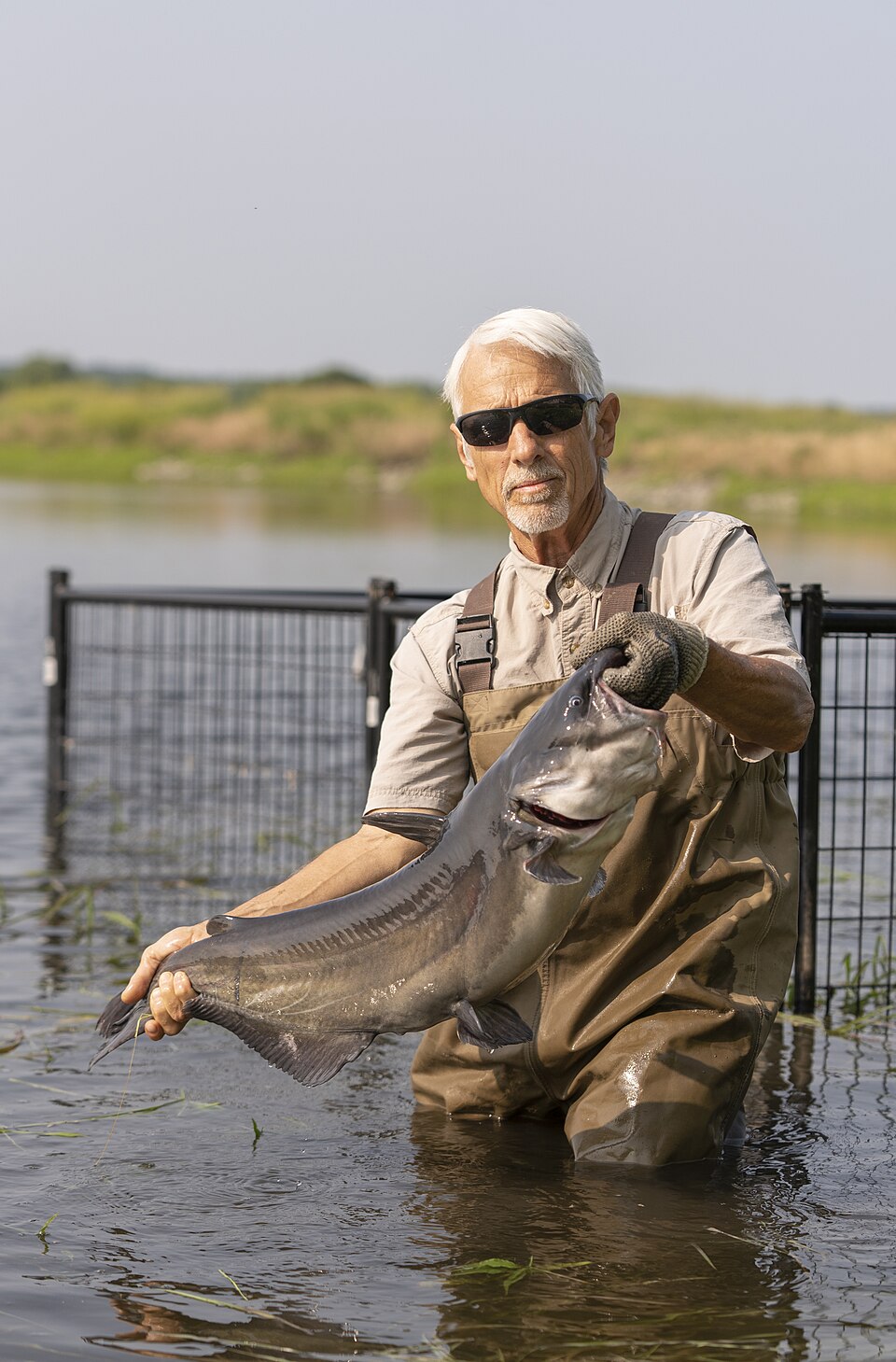
This reference uses the specific documents linked in the article and listed below. Check their scope, publication dates and the statements they support.
A barbel is a sensory organ, not an expendable whisker
Catfish barbels contain sensory structures that help the fish interact with its surroundings and locate food. Different catfish species have different arrangements and functions; not every naturally short barbel is damaged.
Compare the affected fish with its normal species and age pattern. A newly irregular, reddened or shortened structure is more concerning than a stable anatomical difference. Damage near the mouth can also coexist with oral lesions, affecting feed capture beyond the loss of the barbel itself. Observe the fish feeding rather than judge welfare only from a close photograph.
Source: Chemokine C-C motif ligand 33 regulates teleost fish barbel development; Barbel regeneration and function divergence in red-tail catfish; Routine health care of fish.
Trauma is a hypothesis to test against the pattern
A sudden tear after netting or contact with a rough structure is compatible with injury. Progressive tissue loss, inflammation or lesions appearing in many fish should broaden the investigation. A history of bottom contact alone does not prove that the substrate is the sole cause.
Inspect accessible surfaces and routine handling practices for plausible abrasion points. Consider whether competition, water flow or crowding pushes fish repeatedly against them. Do not automatically blame every substrate or replace the entire system before identifying a real exposure. The useful correction is the one that stops new injury without causing additional stress.
Source: Management of aquarium fish; Introduction to fish health management; Fish health management considerations in recirculating aquaculture systems: pathogens.
Water and other lesions help distinguish a local injury from a group problem
Check relevant water conditions and life-support, especially if fish also breathe rapidly or feed poorly. A damaged external surface and an environmental failure can occur together. Apparently clear water does not establish suitable oxygen, nitrogen chemistry or pH.
Look for fin erosion, skin ulcers, mouth lesions or systemic signs elsewhere in the stock. Columnaris and other bacterial problems can damage external tissues, but barbel loss alone does not identify a pathogen. A fish-health professional can decide whether the lesion pattern calls for parasite examination, bacterial testing or another investigation.
Source: Introduction to fish health management; Bacterial diseases in aquaculture; Bacterial diseases of fish.
Protect injured fish without improvised surgery
Avoid trimming a ragged barbel, pulling away tissue or applying a dry-land wound product. Further damage can enlarge the lesion and complicate recovery. Reduce unnecessary capture and correct a demonstrated source of trauma while maintaining suitable conditions.
Medication is a separate decision. Antibiotics should target a supported bacterial problem and comply with food-fish authorization; they do not restore a missing structure directly. A bath that appears suitable for an ornamental catfish is not automatically safe or permitted for a food-producing species. Ask for a realistic objective before treatment begins.
Source: Management of aquarium fish; Aquaculture and aquaculture drugs basics; Introduction to fish health management.
Regeneration is possible, but it is not a guaranteed outcome
Primary work in channel catfish has demonstrated barbel regeneration, and research in other catfish emphasizes functional and species differences. These observations support a potential for repair rather than a promise that every injured barbel will return to normal.
Recovery depends on the remaining tissue, continuing injury and the fish’s overall condition. A research timeline should not be copied as a deadline for a farm case. Feeding, stable body condition and absence of progressive erosion are more useful immediate outcomes than demanding that the barbel reach its original length by a particular day.
Source: Chemokine C-C motif ligand 33 regulates teleost fish barbel development; Barbel regeneration and function divergence in red-tail catfish; Introduction to fish health management.
Escalate when the damage is spreading or function is lost
Seek prompt advice if the lesion extends into the mouth or head, becomes more inflamed, appears in additional fish or is accompanied by reduced feeding, weakness or deaths. Those changes may indicate that a local injury has become part of a broader disease problem.
If fish recover, revisit grading, transfer and feeding arrangements before the next event. If they do not, reassess the original explanation instead of repeatedly adding an antiseptic. The aim is comfortable feeding and a stable protective surface, with any treatable infection addressed on evidence.
Source: Routine health care of fish; Management of aquarium fish; Introduction to fish health management.
Practical questions
Are all short barbels abnormal?
No. Normal anatomy varies by species; a new change matters more than length alone.
Can catfish barbels regrow?
Regeneration is documented, but severity and continuing disease affect the outcome.
Should I trim the damaged end?
No. Leave invasive wound decisions to a qualified fish-health professional.
Related animal-health reading
Cite this reference
LivestockDefense. “Damaged catfish barbels: trauma, progressive erosion and feeding function.” Updated 2026-11-02. https://livestockdefense.com/threats/catfish-traumatic-barbel-erosion/
Add the date you accessed the page. This identifies the current reference; keep a permitted saved copy if your work depends on its exact wording. A citation alone does not establish support for a claim.
How to cite a page and its revision ↗Sources & boundaries
Read the evidence in context.
These documents support the statements identified in this reference. Check their scope and dates when deciding whether they answer your question.
- Merck Veterinary Manual: Bacterial Diseases of Fish
Source update: 2024-09. Most recent check: 2026-10-29.
Water-quality/handling predisposition, overlapping bacterial syndromes, lesion-based identification and susceptibility-guided care.
- U.S. Food and Drug Administration: Aquaculture and Aquaculture Drugs Basics
Source update: Not provided. Most recent check: 2026-10-29.
FDA approves final drug products and intended uses, not active ingredients alone; no treatment authorization, drug choice or dosage inferred from a laboratory result.
- Merck Veterinary Manual: Bacterial diseases in aquaculture
Source update: 2026-06. Most recent check: 2026-11-02.
Bounded clinical distinctions among major fish bacterial diseases; no culture media, incubation, pathogen handling, drug doses or blanket extra-label-feed advice.
- University of Florida IFAS Extension: Introduction to fish health management
Source update: Not provided. Most recent check: 2026-11-02.
Clinical/environmental differential assessment, skin injury and early professional diagnosis; no laboratory or chemical-treatment procedures.
- University of Florida IFAS Extension: Fish health management considerations in recirculating aquaculture systems: pathogens
Source update: Not provided. Most recent check: 2026-11-02.
Shared-water/equipment pathogen amplification and biofilter-sensitive treatment context; no disinfectant or pathogen-handling procedure.
- PNAS / primary developmental research: Chemokine C-C motif ligand 33 regulates teleost fish barbel development
Source update: 2018. Most recent check: 2026-11-02.
Abstract/results for sensory role and demonstrated catfish regeneration only; no genetic manipulation, amputation or invasive protocol and no guaranteed farm recovery time.
- International Journal of Biological Macromolecules / primary research: Barbel regeneration and function divergence in red-tail catfish
Source update: 2023. Most recent check: 2026-11-02.
Abstract inspected for sensory/functional diversity and species distinction, not trauma disease causation or care trial.
- Merck Veterinary Manual: Management of aquarium fish
Source update: Not provided. Most recent check: 2026-11-02.
General clinical injury/environment/targeted-therapy principles, explicitly not species-specific farm trials or food-fish drug authorization. No surgical, injection or aquarium-cycling protocols.
- Merck Veterinary Manual: Routine health care of fish
Source update: 2026-04. Most recent check: 2026-11-02.
General disease signs and water/nutrition/health assessment, not a specific diagnosis of catfish barbel erosion.