
This reference uses the specific documents linked in the article and listed below. Check their scope, publication dates and the statements they support.
Local behavior matters more than the word benign
A small sarcoid may initially cause little discomfort, but local growth can damage skin, interfere with tack or compromise an eyelid. A lesion near the eye or in a rubbing area can become important while still relatively small. Conversely, a stable lesion elsewhere may have a different immediate management priority.
These tumors arise from connective-tissue cells in the skin and are strongly associated with bovine papillomavirus, particularly types 1 and 2. Host and environmental factors also matter. Calling them benign can understate their capacity to cause persistent local disease. The useful discussion is how this lesion is behaving, what function it threatens and whether an early intervention offers a better opportunity for durable control.
Source: Sarcoids; Equine sarcoids.
Different forms can occur on the same horse
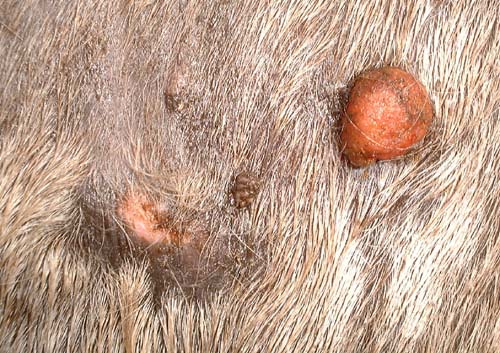
An occult lesion may resemble a flat scaly area of hair loss. Warty forms can resemble thickened skin, while nodular lesions create more discrete lumps. Fibroblastic sarcoids are fleshy and may bleed readily. Mixed lesions combine appearances, and a rare highly aggressive form extends extensively through the skin.
The appearance can change after irritation or incomplete treatment. A growth in an old wound may be mistaken for proud flesh, but a lesion that persists, changes or spreads deserves reassessment. Look beyond the most obvious mass during the veterinary examination because several types can coexist. A photograph can show a change over time but cannot establish tumor identity or depth.
Source: Equine sarcoids; Sarcoids.
Biopsy is a planned decision rather than a forbidden test
Clinical recognition may be convincing when a horse has several characteristic lesions, but an isolated growth can be difficult to distinguish from other tumors or inflammatory disease. Histopathology can establish the diagnosis. Detecting BPV DNA alone does not prove that an unusual lump is a sarcoid.
Because trauma or partial interference can trigger a more aggressive lesion, the veterinarian should plan biopsy alongside definitive management. That risk is not a reason to leave every uncertain mass unidentified indefinitely. Ask whether the result will change treatment and how the site will be managed afterward. Do not shave, cut, squeeze or tie off a suspected lesion at home to test what it is.
Source: Sarcoids; Sarcoids: appearance, diagnosis and treatment.
There is no single treatment that is best for every sarcoid
The clinician considers location, size, number, form, previous treatment and the horse’s ability to tolerate care. Surgery, selected local medication, laser, cryotherapy, radiotherapy or other specialist approaches may be appropriate, sometimes in combination. A method that suits a trunk lesion may be unsuitable next to the eye or over a vital structure.
A systematic review found a limited and heterogeneous evidence base with important risk of bias. Reported success rates from different studies cannot be placed in a simple league table because lesion selection and follow-up differ. Ask whether a proposed outcome refers to one tumor or the whole horse, and whether recurrence was assessed over a meaningful period.
Source: Treatment of equine sarcoids: a systematic review; Sarcoids: appearance, diagnosis and treatment.
Home remedies can turn a manageable lesion into a difficult wound
Caustic pastes, cutting, rubber bands and unprescribed topical agents can cause tissue injury, pain or incomplete tumor destruction. The risk is particularly serious around an eye, a joint or thin skin. A product sold as natural is not automatically gentle or effective.
Some veterinary antitumor medications also require careful handling and protection of normal tissue. Treatment should come with clear instructions about expected local changes, pain control and when to call for review. Ulceration or inflammation may occur during treatment, but an owner should not have to guess whether severe discomfort is acceptable. A healing wound still requires reassessment for residual tumor.
Source: Skin tumors in horses; Sarcoids: appearance, diagnosis and treatment.
Long-term control includes recurrence and the horse’s daily comfort
A lesion can recur after apparent removal, sometimes in a more difficult form. Recurrence does not necessarily mean every treatment option is exhausted, but the original plan should be reconsidered rather than repeated automatically. Large lesions, difficult anatomical sites and previous failed interventions can complicate control.
Useful follow-up assesses the treated site, other skin lesions, comfort and function. Check whether tack rubs, flies or moisture are aggravating ulcerated tissue and make practical changes. A working donkey or horse with a mass under its harness may need immediate relief from that pressure even while specialist treatment is arranged. If extensive disease cannot be controlled comfortably, welfare should guide the next decision.
Source: Skin tumors in horses; Sarcoids; Equine sarcoids.
Prevention claims should reflect the unresolved transmission picture
There is no established universally effective preventive vaccine or husbandry method that eliminates sarcoid risk. The role of BPV is strong, but the exact natural transmission mechanisms between animals are not fully established. Detection of viral material in flies does not by itself prove how an individual horse developed its tumor.
Reasonable wound care, fly reduction and avoiding contaminated shared equipment are sensible skin-health measures. They should not be advertised as a guarantee that sarcoids will disappear or never develop. Early assessment of a new suspicious lesion gives a more useful opportunity to protect function than waiting until bleeding, rubbing or extensive growth forces an emergency decision.
Source: Equine sarcoids; Sarcoids; Treatment of equine sarcoids: a systematic review.
Practical questions
Is every wart-like growth a sarcoid?
No. Other tumors, papillomas and inflammatory lesions can resemble it.
Should sarcoids never be biopsied?
No. Biopsy can be important when diagnosis is uncertain, but it should be planned with the treatment strategy.
Does removal guarantee a cure?
No. Recurrence is common enough that the chosen method and follow-up should be discussed in advance.
Related animal-health reading
Cite this reference
LivestockDefense. “Equine sarcoids: locally invasive skin tumors and choosing a treatment plan.” Updated 2026-11-02. https://livestockdefense.com/threats/equine-sarcoids/
Add the date you accessed the page. This identifies the current reference; keep a permitted saved copy if your work depends on its exact wording. A citation alone does not establish support for a claim.
How to cite a page and its revision ↗Sources & boundaries
Read the evidence in context.
These documents support the statements identified in this reference. Check their scope and dates when deciding whether they answer your question.
- UC Davis Center for Equine Health: Sarcoids
Source update: 2024-12-18. Most recent check: 2026-11-02.
Local behavior, clinical forms, diagnosis and individualized care; no reproduced article or home treatment instructions.
- Merck Veterinary Manual: Equine sarcoids
Source update: 2024-09. Most recent check: 2026-11-02.
BPV association with unresolved transmission, morphology, biopsy risk and recurrence; excludes drug, ligation or destructive-treatment procedures.
- Equine Veterinary Journal / systematic review: Treatment of equine sarcoids: a systematic review
Source update: 2024. Most recent check: 2026-11-02.
Indexed abstract on small heterogeneous evidence base and inability to rank one universal best treatment; not a new comparative efficacy claim.
- Royal Veterinary College: Sarcoids: appearance, diagnosis and treatment
Source update: Not provided. Most recent check: 2026-11-02.
Official indexed text inspected; direct access restricted. Bounded clinical statements on site/type-dependent treatment and biopsy planning; no procedural content.
- American College of Veterinary Surgeons: Skin tumors in horses
Source update: Not provided. Most recent check: 2026-11-02.
Signs prompting assessment, diagnosis, site-specific treatment and aftercare; excludes surgical methods and does not generalize sarcoid metastasis.