
This reference uses the specific documents linked in the article and listed below. Check their scope, publication dates and the statements they support.
A damaged skin barrier rather than dirty feet alone
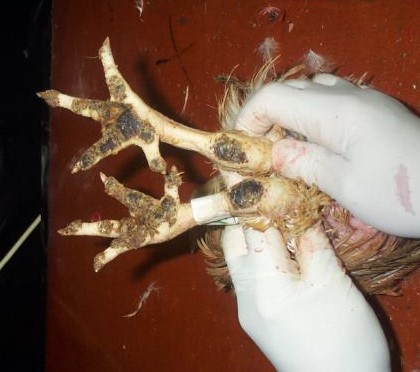
Dark areas on a footpad may be more than adhering dirt. The Virginia Cooperative Extension guide describes lesions ranging from superficial changes to deeper ulcers, sometimes with blackened dead tissue. A surface that looks muddy should not be scrubbed aggressively in an attempt to make the diagnosis disappear.
The footpad normally protects underlying tissues during standing and walking. Persistent contact damage compromises that barrier and can open a route for secondary infection. The depth of injury matters: an early superficial lesion and a swollen infected foot require different levels of care.
How wet litter becomes a flock problem
Litter quality reflects water entering the building and moisture leaving it. Leaking or poorly adjusted drinkers, wet droppings, inadequate ventilation and compacted areas can all contribute. A whole house may appear acceptable while one drinker line or a favored resting corner remains persistently wet.
A primary experiment in floor-housed laying hens found that litter moisture and environmental conditions contributed to footpad lesions. Its results support the importance of the standing surface; they should not be converted into a fixed prediction of how many birds will be affected on another farm.
Examine the areas the birds actually use. Litter near a wall, under a drinker or at the edge of a ventilation pattern may differ from the dry material in a central aisle. Correct the reason moisture accumulates rather than repeatedly adding a dry covering while the same leak continues beneath it.
Recognizing pain and reduced movement
Birds with painful feet may walk less, sit longer or hesitate to approach a feeder. Some remain active despite substantial lesions, so activity alone is not a complete measure of foot health. Assess feet and movement together with an experienced poultry adviser or veterinarian.
A bird that cannot comfortably obtain feed or water needs prompt attention. Consider whether a safe care area can reduce competition and provide a more suitable standing surface while assessment is arranged. Do not leave a severely lame bird in a group where others repeatedly step on it.
Observe both feet without forcing a painful bird to perform repeated walks. The appearance, swelling and the bird's ability to bear weight help the veterinarian decide what should happen next. A photo may illustrate the surface, but cannot establish the depth of a lesion.
Footpad dermatitis and bumblefoot overlap, but are not identical questions
The word pododermatitis means foot inflammation and is used broadly. In practice, keep surface contact damage distinct from a deep infected swelling or abscess. The Merck staphylococcosis chapter describes injury-associated foot infections and the deeper tissue consequences that may accompany bumblefoot.
Marked swelling, heat, discharge, increasing lameness or an unwell bird warrants veterinary assessment. Do not assume that every lesion needs the same topical product, or that improving litter will remove an established deep infection. Conversely, routine antibiotic use is not a substitute for correcting ongoing contact damage.
Avoid home surgery, cutting out plugs or squeezing a swollen foot. Virginia Cooperative Extension specifically warns against do-it-yourself operations. These cause pain and can worsen the injury; a veterinarian can determine whether a procedure, analgesia or other treatment is appropriate.
Repair the environment the bird returns to
Provide dry, workable bedding and correct water leaks or drinker settings. Assess ventilation with regard to moisture as well as temperature. Reducing airflow simply because outdoor conditions are cool may leave the house unable to remove the moisture produced by the flock.
If droppings are unusually wet, investigate feeding, water intake and intestinal health with the relevant advisers. A bedding problem can have an animal-health contribution, while an intestinal concern does not remove the need for a suitable surface. Address both parts rather than choose one explanation prematurely.
Stocking and resource access also matter. Birds need enough usable space to move, rest and reach resources without remaining in a wet, crowded patch. A mathematical floor-area allowance does not describe every obstruction, unusable corner or competition point in the enclosure.
Broilers, laying hens and turkeys
Footpad dermatitis is important in broilers, but it is not confined to fast-growing meat chickens. The Virginia Tech guide also discusses laying hens and turkeys. Different housing and body sizes change the practical investigation, yet the basic need for a comfortable standing surface remains.
For broilers, integrate litter and drinker care with growth-stage needs rather than assume poor movement is an inevitable consequence of size. In layers, inspect the approaches to nests, perches and resources as well as open litter. For turkeys, consider the space and access required by the actual growing birds.
The broiler, laying-hen and turkey pages provide related husbandry. The poultry brooding guide explains how early environmental management fits feed, water and litter together.
Recovery means comfort as well as a smaller lesion
Follow the veterinarian's care plan and reassess the bird's movement and feeding. A drier pen is an improvement, but a painful established lesion may still need treatment. Repeatedly returning a recovering bird to the same wet area undermines the practical purpose of foot care.
Ask what worsening signs should prompt another call and how frequently a treated foot should be assessed. The answer depends on depth, infection and the type of care used. Do not assume that one bandaging or cleaning method fits all poultry feet.
Is a black spot proof of a deep abscess?
No. A dark lesion can reflect different degrees of skin damage. Depth, swelling, pain and the rest of the examination guide the diagnosis and treatment.
Can changing the bedding replace veterinary care?
It can remove an important continuing risk, but it cannot establish that an ulcer or deep infection has healed. A bird with marked lameness, swelling or poor access to resources needs individual attention.
Cite this reference
LivestockDefense. “Footpad dermatitis in poultry: wet litter, painful lesions and prevention.” Updated 2026-11-02. https://livestockdefense.com/threats/footpad-dermatitis-broiler-chickens/
Add the date you accessed the page. This identifies the current reference; keep a permitted saved copy if your work depends on its exact wording. A citation alone does not establish support for a claim.
How to cite a page and its revision ↗Sources & boundaries
Read the evidence in context.
These documents support the statements identified in this reference. Check their scope and dates when deciding whether they answer your question.
- Virginia Cooperative Extension / Virginia Tech: Footpad dermatitis in poultry: a common issue in commercial and backyard flocks
Source update: Not provided. Most recent check: 2026-11-02.
Clinical identity, signs, diagnostic interpretation and prevention statements bounded to the sections mapped in the pig/poultry condition article.
- Wang, Ekstrand and Svedberg / British Poultry Science: Wet litter and perches as risk factors for the development of foot pad dermatitis in floor-housed hens
Source update: 1998-05. Most recent check: 2026-11-02.
Primary experiment abstract inspected for association of litter moisture and conditions with footpad lesions in floor-housed hens; no universal prevalence or stocking prescription inferred.
- Merck Veterinary Manual: Staphylococcosis in poultry
Source update: Not provided. Most recent check: 2026-11-02.
Clinical identity, signs, diagnostic interpretation and prevention statements bounded to the sections mapped in the pig/poultry condition article.