
Black soldier fly production stages
- Eggs
Protected egg-laying and hatch arrangements
- Young larvae
Suitable starter substrate and careful transfer
- Growing larvae
Controlled feed, moisture, depth and temperature
- Prepupae and pupae
Transition to the adult breeding stage
- Adults
Mating and egg production maintain the colony
This reference uses the specific documents linked in the article and listed below. Check their scope, publication dates and the statements they support.
Animal at a glance
| Topic | Overview |
|---|---|
| Animal group | Hermetia illucens; larva and adult have different production roles |
| Production roles | Larvae and processed ingredients for specified feed chains |
| Life stages | Egg, feeding larva, later stages and breeding adult |
The larval product depends on an adult breeding system
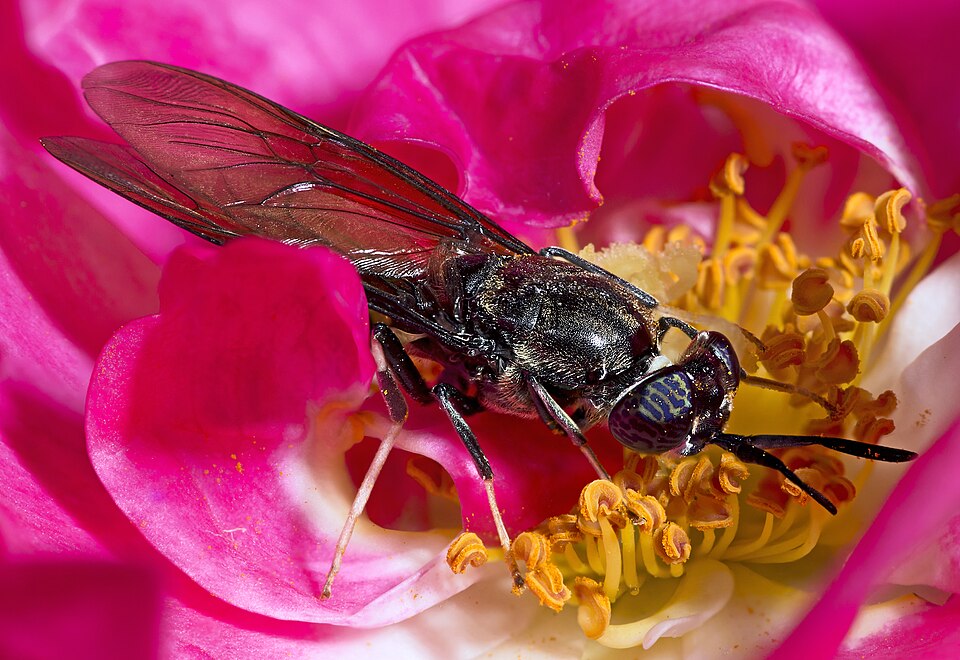
Black soldier flies, Hermetia illucens, are not houseflies. Their larvae are the principal harvested stage in many production systems, while adults and eggs maintain the breeding pipeline. A photograph of an adult identifies the species; it does not show the larval feeding environment or prove that the farm's product is suitable for a particular livestock ration.
FAO's feed overview describes the interest in soldier fly larvae. Commercial use still depends on the species, input material, processing and intended market. Potential is not the same as permission to feed every substrate or sell every product.
Separate useful bioconversion from food-chain safety
Larvae can use a range of organic materials, but the ability to consume a material does not demonstrate removal of all its hazards. Choose inputs of known origin and permitted status for the destination product. Do not use a mixed waste stream of uncertain composition as feed for animals intended for the food chain.
Control foreign objects, chemical residues and spoilage before the material enters the rearing area. A single convenient supplier does not remove the need to assess changes in its ingredients or handling. FAO's broader insect assessment explains why substrate and product safety require attention. The substrate selection guide provides a practical decision sequence.
Moisture and depth affect the larval environment
Feed must be physically usable by the larvae, while the rearing system must avoid unsuitable wet or overheated pockets. Container depth, input quantity, ventilation and the density of active larvae influence conditions inside. Monitor the occupied material rather than only the air outside the container.
Drainage and leachate need a deliberate arrangement. Do not allow liquid from a dirty input area to pass through clean harvest or breeding spaces. Spillage that attracts other flies, rodents or birds is an environmental management problem, not evidence that the system is naturally self-cleaning.
Add material according to a controlled production plan. Repeatedly covering a poorly performing layer with new feed can hide the underlying problem. Review whether the larvae are the expected stage, whether the material is suitable and whether the container's conditions have moved outside the intended range.
Adults, eggs and young larvae need their own plan
Breeding adults require an environment that supports mating and egg laying, and eggs need suitable conditions through hatch. A productive larval tray does not by itself guarantee a dependable breeding colony. Develop enough breeding capacity to supply the planned number of grow-out units without continually buying unknown stock.
Protect eggs and early larvae during transfer. Use clean, appropriate equipment and minimize avoidable drying, overheating or contamination. Keep the life stages distinct enough that each can be managed and assessed without disrupting all the others.
Harvest is the beginning of product control
Decide whether the intended product is live larvae, dried whole larvae, a defatted meal or another ingredient. Those products differ in composition and handling. A livestock nutritionist should formulate them into a complete ration rather than assuming one kilogram replaces the same amount of another protein ingredient.
Processing needs a verified hygiene and storage plan. Drying that leaves a damp center or storage that permits rewetting can undermine the product. Residual rearing material also needs an appropriate management route; it should not be assumed pathogen-free or universally approved as fertilizer merely because larvae have passed through it.
Investigate production failure before expanding
Unexpected deaths, poor growth, abnormal movement or a failure of adults to produce viable eggs call for a review of environment, feed, handling and possible disease. Avoid transferring material from a failing unit into breeders while the cause is unknown. Seek technical insect-production support rather than using unapproved pesticides or animal medicines.
Will larvae make any waste safe?
No. Consumption and hazard removal are different questions. Controlled inputs and validated processing remain necessary.
Can the larvae be fed directly to any livestock?
Not automatically. Confirm permitted species and substrates, product safety and nutritional suitability for the receiving animal and market.
Continue reading
Field guides for this animal
Browse all Black soldier flies field guides for husbandry advice, health explanations and practical farm routines.
Cite this reference
LivestockDefense. “Black soldier flies: larval feed, breeding, moisture and product safety.” Updated 2026-11-02. https://livestockdefense.com/animals/black-soldier-flies/
Add the date you accessed the page. This identifies the current reference; keep a permitted saved copy if your work depends on its exact wording. A citation alone does not establish support for a claim.
How to cite a page and its revision ↗Sources & boundaries
Read the evidence in context.
These documents support the statements identified in this reference. Check their scope and dates when deciding whether they answer your question.
- FAO: Insects for feed
Source update: Not provided. Most recent check: 2026-11-02.
Bounded production identity and species context cited in the global livestock hubs. Practical examples are editorial suggestions. Historical sources do not establish current local market permissions or clinical protocols.
- FAO: Edible insects: future prospects for food and feed security
Source update: Not provided. Most recent check: 2026-11-02.
Insect production biology, food/feed uses, substrate quality and the need for product-specific food safety assessment.