
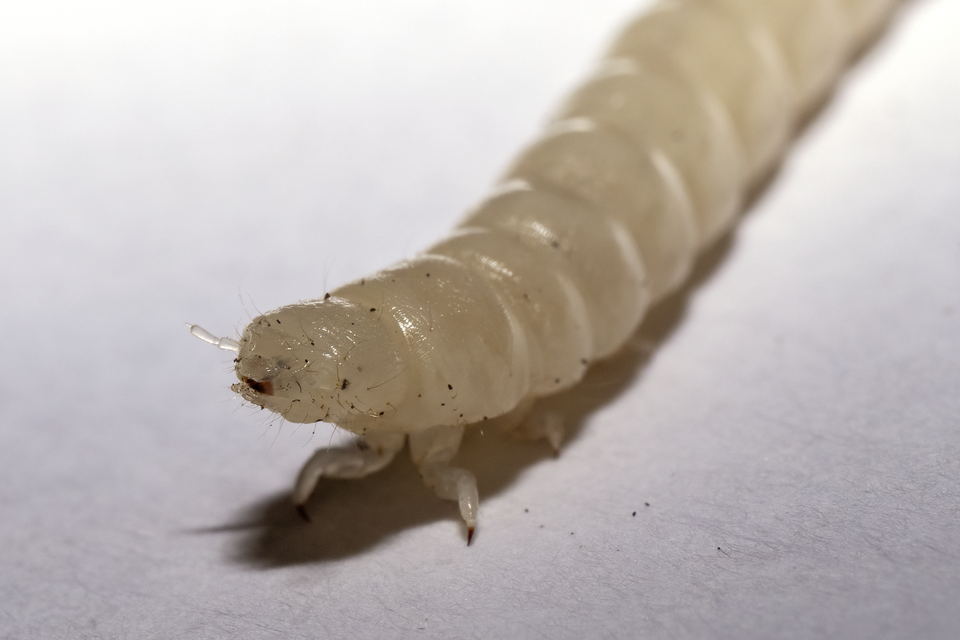
Mealworm production life stages
- Eggs
Develop within the breeding medium
- Larvae
Feeding stage commonly harvested as mealworms
- Pupae
Nonfeeding transformation stage
- Adult beetles
Breeding stage producing the next generation
This reference uses the specific documents linked in the article and listed below. Check their scope, publication dates and the statements they support.
Animal at a glance
| Topic | Overview |
|---|---|
| Animal group | Larvae of beetles, including Tenebrio molitor |
| Production roles | Specified food or animal-feed products |
| Life stages | Egg, larva, pupa and breeding beetle |
The product is one stage of a complete life cycle
The familiar yellow mealworm is a larva, not an adult worm. It develops through a pupal stage into a darkling beetle that produces the next generation. A farm harvesting larvae therefore also needs a reliable breeding system, even if the beetles are never sold.
FAO's insect-food and feed reference places mealworms among farmed insect resources. Product identity still matters: different insects sold as mealworms or superworms should not be assumed to have identical biology, production conditions or legal status.
Treat the feeding medium as an input and an environment
Mealworm larvae live in close contact with their feed. A suitable dry ingredient can function as both food and rearing medium, so its quality affects the whole tray. Check its source, composition, moisture and intended use. Do not use visibly moldy grain or uncertain waste simply because larvae can survive in it.
Any moisture source must be managed without creating patches of spoiled feed. Replace unsuitable wet material and inspect beneath it, where deterioration may be hidden. A dry surface does not prove the entire tray is dry. The insect substrate guide explains why ingredient approval, nutrition and hazard control are separate questions.
Tray depth and stocking affect the conditions within
The rearing tray is a small environment. Air movement, moisture and heat can vary within densely occupied material. Monitor the occupied medium rather than relying only on the room's thermostat. If animals cluster at edges or performance changes in the deepest part, examine the conditions there.
Choose tray systems that can be cleaned, inspected and handled safely. A shelf arrangement should allow practical access without spilling substrate between cohorts. Keep lids and ventilation openings secure against escape and pest entry. Increasing the number of trays is easier than increasing the capacity to clean them properly; expand both together.
Protect the breeding pipeline
Retain an appropriate number of healthy animals for pupation and adult breeding. Harvesting every large larva can leave no replacement generation. Conversely, keeping all stages together indefinitely makes production less predictable and complicates cleaning and separation.
Use a stage-management approach suitable for the particular species. Eggs and tiny larvae can be difficult to see, so discarding used breeding material or moving it between rooms needs a deliberate process. Treat uncertain substrate as potentially containing live stages until it is handled through the farm's containment and sanitation plan.
The pale appearance of a newly molted larva can be normal. Persistent failure to develop, widespread abnormality or an increase in deaths is different and should prompt investigation. Do not diagnose a production problem from color alone.
Control contamination before harvest
Exclude rodents, wild beetles and other pests, and keep tools for dirty waste separate from those used for clean feed and harvested insects. Remove dead material and clean equipment between cohorts with a method appropriate to the system. Reusing a tray is not equivalent to reusing its contaminated contents.
Assess a failed group before transferring its surviving animals into breeders. Repeatedly mixing survivors may move a feed, environmental or infectious problem through the operation. Review input changes and actual tray conditions with a competent insect-production adviser.
Food and feed uses need their own safety plan
Mealworm composition varies with species, feed and processing. A dried insect meal should be formulated as an ingredient rather than treated as a nutritionally complete replacement for livestock feed. FAO's feed overview describes potential applications, not unrestricted approval for every animal or market.
For human food, resolve permitted species, processing, labeling and allergen requirements before sale. Clean-looking larvae are not proof that a batch is microbiologically or chemically safe, and a preparation suitable for pet feed is not automatically suitable for people.
Are mealworms the same as black soldier fly larvae?
No. They are different insects with different life cycles, feed systems and production characteristics.
Why keep adult beetles if only larvae are sold?
The adults produce the next generation. Breeding stock is part of the production system, not a separate optional hobby.
Continue reading
Field guides for this animal
Browse all Mealworms field guides for husbandry advice, health explanations and practical farm routines.
Cite this reference
LivestockDefense. “Farmed mealworms: larvae, beetle breeding, feed and tray care.” Updated 2026-11-02. https://livestockdefense.com/animals/mealworms/
Add the date you accessed the page. This identifies the current reference; keep a permitted saved copy if your work depends on its exact wording. A citation alone does not establish support for a claim.
How to cite a page and its revision ↗Sources & boundaries
Read the evidence in context.
These documents support the statements identified in this reference. Check their scope and dates when deciding whether they answer your question.
- FAO: Insects for feed
Source update: Not provided. Most recent check: 2026-11-02.
Bounded production identity and species context cited in the global livestock hubs. Practical examples are editorial suggestions. Historical sources do not establish current local market permissions or clinical protocols.
- FAO: Edible insects: future prospects for food and feed security
Source update: Not provided. Most recent check: 2026-11-02.
Insect production biology, food/feed uses, substrate quality and the need for product-specific food safety assessment.