
This reference uses the specific documents linked in the article and listed below. Check their scope, publication dates and the statements they support.
Animal at a glance
| Topic | Overview |
|---|---|
| Animal group | Cairina moschata, distinct from mallard-derived domestic ducks |
| Production roles | Food birds and breeding stock |
| Life stages | Duckling, growing bird and breeding adult |
Do not treat Muscovies as nonflying Pekins
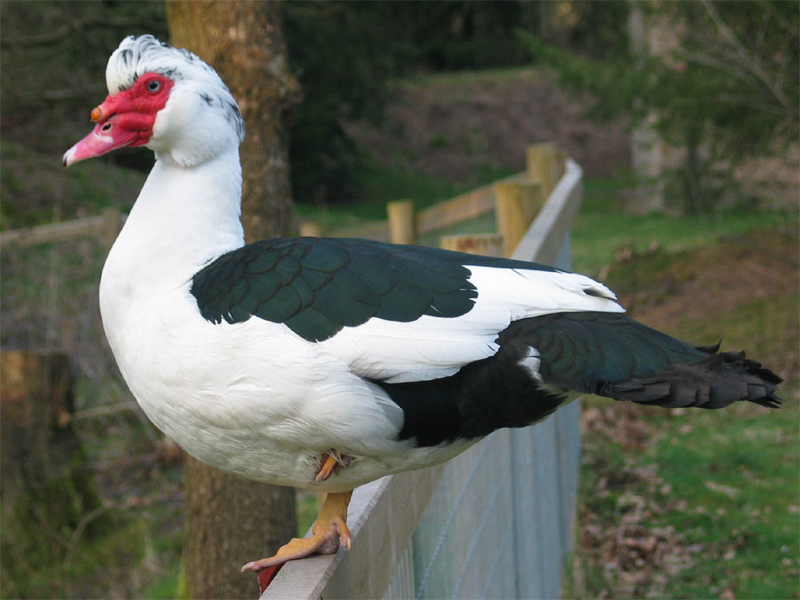
Muscovy ducks belong to a different species from the mallard-derived domestic duck breeds. They can fly well enough to make a low fence inadequate. Cornell's duck housing guide specifically distinguishes Muscovy containment from that of Pekins.
Plan secure boundaries, access and shelter before adding birds. Escape prevention should rely on appropriate housing rather than improvised injurious procedures. If several poultry types share a property, separate their feed and breeding arrangements so the smaller or less assertive birds are not displaced.
Manage drinking water and wet ground separately
Ducks create a wet environment around drinkers. Use water equipment that permits normal drinking while keeping the main bedding area as dry as possible. Drainage, placement and frequent cleaning matter more than repeatedly adding bedding over a permanently soaked patch.
Water for drinking must remain clean and accessible. A pond is not proof of adequate water quality, and natural forage around it does not necessarily supply a balanced ration. If providing bathing water, plan how it will be maintained and how birds will enter and leave safely. Ducklings need arrangements appropriate to their age, with protection against chilling and drowning.
Ventilation must remove moisture without creating cold drafts across young birds. Inspect the bedding beneath the surface, especially near walls and water points. Wet litter, stale air and crowding should be corrected as environmental problems rather than treated with a routine dose of medicine.
Feed for the bird and its stage
Use a feed appropriate to ducklings, growing Muscovies or breeders. Do not assume a medicated chicken feed is suitable, and do not dilute a complete ration with large quantities of grain or food scraps. Check the label and ask the supplier or veterinarian where suitability is uncertain.
Foraging can contribute to the diet, but its contribution varies. A flock receiving pasture access still needs assessment of body condition and feed intake. Protect stored feed against damp, rodents and wild birds, and provide multiple access points where competition is apparent.
Brood ducklings with attention to footing and dryness
Prepare a warm, dry brooding space before hatch or arrival. Provide room to move away from the warmest area and judge comfort from behavior as well as equipment readings. Ducklings that pile, become wet or cannot walk securely need an immediate review of the setup.
Place food and water within easy reach. A healthy-looking group can include a smaller duckling excluded at the feeder. Check for poor growth, persistent sitting or abnormal gait rather than assuming every problem is inherited. Arrange professional advice before adding supplements or changing feed repeatedly.
Breeding, nesting and flock welfare
Select healthy breeders and provide quiet nesting areas protected from predators and repeated disturbance. Consider the size difference between drakes and females when assessing mating injury. A persistently injured female should not simply be returned to the same group after a brief recovery.
Keep hatch and rearing arrangements appropriate to Muscovies; incubation practices for common domestic ducks should not be copied without checking species requirements. If hybrids with other domestic ducks are part of a commercial system, their breeding and production role needs to be understood before birds are purchased.
Health and outside contact
Outdoor waterfowl can contact wild birds through shared water and feeding areas. Protect feed, limit unnecessary shared equipment and have a practical plan for confinement if required by animal-health authorities. Sudden mortality, neurological signs or respiratory distress require prompt veterinary advice; an image of a healthy Muscovy cannot rule out flock disease.
Do Muscovies need a large pond?
Housing design must meet drinking, bathing and welfare needs, but water area alone does not determine quality of care. Dry resting space, drainage and hygienic management remain essential.
Can Muscovies use any duck incubation program?
No. Check guidance for the actual species and production stock; differences from mallard-derived breeds matter.
Continue reading
Cite this reference
LivestockDefense. “Muscovy ducks: feeding, dry housing, brooding and breeding.” Updated 2026-11-02. https://livestockdefense.com/animals/muscovy-ducks/
Add the date you accessed the page. This identifies the current reference; keep a permitted saved copy if your work depends on its exact wording. A citation alone does not establish support for a claim.
How to cite a page and its revision ↗Sources & boundaries
Read the evidence in context.
These documents support the statements identified in this reference. Check their scope and dates when deciding whether they answer your question.
- FAO: Small-scale poultry production: species and breeds
Source update: Not provided. Most recent check: 2026-11-02.
Bounded species biology, feeding context and production or husbandry statements attributed to this document in the animal overview sections. No numerical feeding, medication, restraint or breeding protocol reproduced.
- Cornell University College of Veterinary Medicine: Duck housing and management
Source update: Not provided. Most recent check: 2026-11-03.
Document scope and recorded checks
Warm dry brooding, nearby feed/water and avoiding overcrowding.
Entries retain the date and scope of each recorded inspection.
- 2026-11-03 — Ducks require dry sheltered resting areas and special attention to litter moisture; duck water use differs from chickens. No fixed stocking or equipment values transferred.
Exact primary/official publisher page or its indexed text inspected for these bounded statements on 2026-11-03.
- 2026-11-02 — Warm dry brooding, nearby feed/water and avoiding overcrowding.
Primary page or indexed primary-source excerpt inspected for the listed bounded subject; not a comprehensive clinical review
- 2026-11-03 — Ducks require dry sheltered resting areas and special attention to litter moisture; duck water use differs from chickens. No fixed stocking or equipment values transferred.