
This reference uses the specific documents linked in the article and listed below. Check their scope, publication dates and the statements they support.
Animal at a glance
| Topic | Overview |
|---|---|
| Animal group | Marine echinoderms, rather than molluscs or plants |
| Production roles | Food animals and processed products such as bêche-de-mer |
| Life stages | Hatchery stock, nursery, grow-out and processing lot |
Different species need different production assumptions
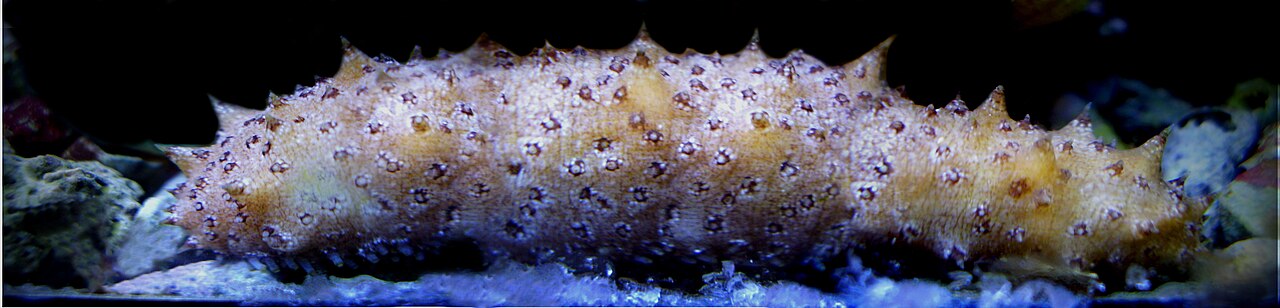
Sea cucumbers belong to the echinoderms, alongside animals such as sea stars and sea urchins. The food-animal trade includes several species, so a general sea cucumber label is insufficient for choosing a farm design. Sandfish, Holothuria scabra, are one tropical example with established hatchery techniques.
SEAFDEC's sandfish production overview describes their association with shallow sandy-muddy habitats and the distinction between hatchery, nursery and later production. A method developed for tropical sandfish should not be promised to work unchanged for a temperate species.
Larvae are not miniature bottom-feeding adults
The hatchery begins with eggs and swimming larvae before the animals settle and metamorphose. Early food and water management differ from the needs of larger bottom-associated juveniles. A supply of suitable microalgae may be central to larval production even when the eventual grow-out animals feed from the sediment environment.
This life-stage difference is a good reason to purchase reliable hatchery seed when the farm lacks larval expertise. A pen in a coastal growing area does not reproduce the controlled conditions of a hatchery. Attempting the entire production chain should be a deliberate technical decision.
Small settled juveniles commonly pass through nursery stages before they are ready for the final growing habitat. The nursery must retain tiny animals, provide suitable food and allow their condition to be assessed without rough handling. Fine mesh and settlement surfaces need maintenance because a small change in fouling or flow can affect a concentrated group.
Sediment is habitat and a food resource
Many cultured food species process material associated with the seabed. Their feeding connects production to the quality and extent of the usable substrate. FAO's sea cucumber ecosystem review describes their role in nutrient recycling and sediment health.
This does not mean that sea cucumbers can be placed into any polluted or heavily loaded area as a cleanup service. A waste material may be present without being safe or nutritionally suitable. The growing environment must be assessed for the animal's needs and the intended food product.
Bottom area and condition may be more informative than water volume alone. A deep tank with little usable habitat can still provide limited feeding opportunity. A pen that appears spacious may contain patches unsuitable for the stocked species.
Stocking, movement and shelter
Choose a stock size that fits the nursery or growing system. Tiny juveniles are difficult to retain and assess in a large open environment, while larger seed may cost more but need a different level of protection. The production plan should identify which transition the farm is prepared to manage.
Avoid assuming that animals will distribute themselves evenly. Habitat quality, available food and enclosure layout can affect where they gather. Inspect several parts of the growing area rather than judging the entire crop from the animals easiest to see near an access point.
Escape prevention and predator management should fit the site without creating unnecessary habitat damage. Use lawful managed production and reliable seed sources. An interest in aquaculture should not turn into opportunistic collection from already pressured wild stocks.
Handling and welfare
Sea cucumbers have soft bodies that can be damaged by rough handling, compression or unsuitable holding conditions. Transfers should be planned around appropriate water, containers and minimal waiting. They should not be squeezed or exposed merely to demonstrate a defensive response.
Abnormal appearance, loss of normal activity, lesions or unexpected mortality warrant technical investigation. Environmental conditions, handling and disease may need to be considered together. A soft-bodied animal can be compromised without the obvious injuries familiar from fish or livestock.
FAO's selected-species culture chapter provides additional biological context for particular cultured sea cucumbers. Its species and historical setting should be kept in mind: a general reference can explain a production principle without becoming a universal stocking or treatment prescription.
Food production and responsible expansion
The final product can involve specialist handling and processing. A grow-out farm should establish a competent market and processing route before increasing stock. A high quoted price for a dried product is not the value of every live juvenile placed into a pen.
Site suitability, lawful access, environmental approvals and reliable juvenile supply should be resolved before expansion. These are practical conditions for a stable enterprise, not substitutes for daily animal care.
Are sea cucumbers plants or molluscs?
Neither. They are echinoderms. Their feeding and life cycle should be understood on their own terms rather than borrowed from seaweed or bivalve farming.
Can juveniles be placed directly into any coastal pen?
No. Seed size, habitat, food, protection and the species' local environmental requirements determine whether the receiving area is suitable. Nursery progression is an important part of many production programmes.
Continue with practical guidance
Cite this reference
LivestockDefense. “Sea cucumber farming: sandfish seed, sediment food and nursery habitats.” Updated 2026-11-02. https://livestockdefense.com/animals/sea-cucumbers/
Add the date you accessed the page. This identifies the current reference; keep a permitted saved copy if your work depends on its exact wording. A citation alone does not establish support for a claim.
How to cite a page and its revision ↗Sources & boundaries
Read the evidence in context.
These documents support the statements identified in this reference. Check their scope and dates when deciding whether they answer your question.
- FAO: Biology and culture of selected species
Source update: Not provided. Most recent check: 2026-11-02.
Bounded species biology, feeding context and production or husbandry statements attributed to this document in the animal overview sections. No numerical feeding, medication, restraint or breeding protocol reproduced.
- FAO: Managing sea cucumber fisheries: ecosystem function
Source update: Not provided. Most recent check: 2026-11-02.
Bounded species biology, feeding context and production or husbandry statements attributed to this document in the animal overview sections. No numerical feeding, medication, restraint or breeding protocol reproduced.
- SEAFDEC Aquaculture Department: Farming sea cucumber
Source update: Not provided. Most recent check: 2026-11-02.
Species biology, life stages and the bounded practical husbandry facts cited in the aquatic animal overview or supporting guide; no drug dose, invasive procedure, universal stocking rate or complete clinical protocol.