
This reference uses the specific documents linked in the article and listed below. Check their scope, publication dates and the statements they support.
Animal at a glance
| Topic | Overview |
|---|---|
| Animal group | Air-breathing aquatic reptiles; identify the actual species |
| Production roles | Specialist food-animal and breeding systems |
| Life stages | Breeder, hatchling and growing turtle |
Identify the turtle rather than the food name
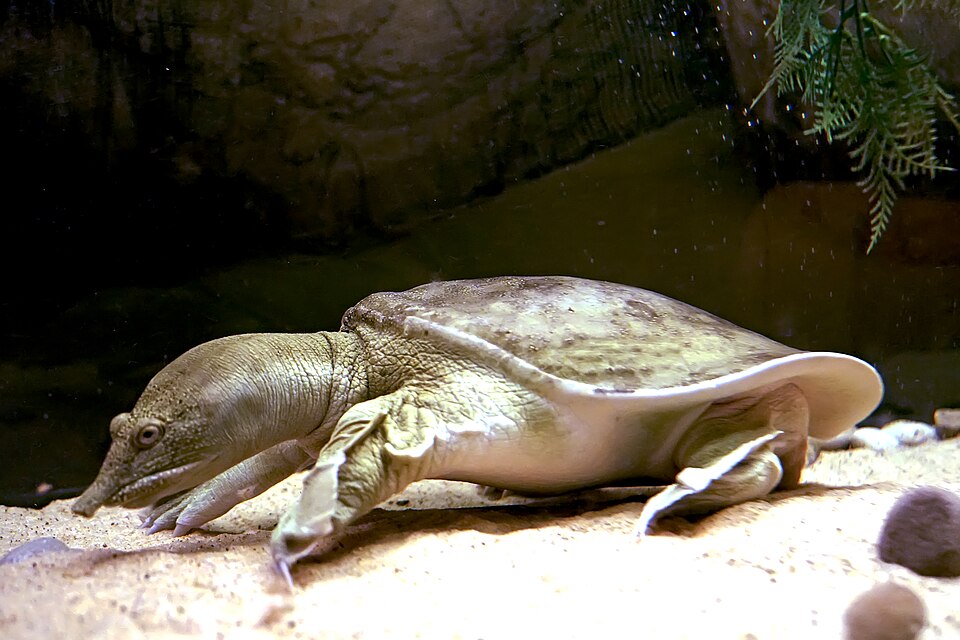
Chinese softshell turtle, Pelodiscus sinensis, appears under the older name Trionyx sinensis in FAO's culture profile. Other turtles sold under food or regional names may be different species. That distinction matters for care, lawful supply and the production environment.
Softshell turtles have a different body covering from the hard scutes familiar on many other turtles. Their appearance should not be judged using a hard-shelled species as the only reference. At the same time, abrasions, ulcers or damaged tissue deserve attention rather than dismissal because the animal naturally has a soft outer covering.
Water does not replace access to air and land
An aquatic turtle remains a reptile that uses air. Enclosures should allow normal access to the surface and provide the species-appropriate areas needed outside the water. FAO describes breeding ponds with accessible banks and nesting areas; those features serve animal needs rather than merely providing a convenient path for staff.
The MSD explanation of reptile housing emphasizes that temperature, sanitation and habitat must fit the species. A production pond needs the same biological attention even though it contains many animals rather than one companion reptile.
Provide safe transitions between water and the areas animals are expected to use. A steep or abrasive edge can make an apparently generous land area difficult to reach. The design should also retain animals securely without sharp contact points or gaps that cause repeated injury.
Temperature is part of feeding and welfare
Reptiles use environmental conditions to regulate body temperature. The relevant question is whether the animal can access an appropriate range, not simply whether one thermometer shows a warm number. Water, exposed surfaces and shaded areas can present different conditions within the same enclosure.
Obtain a species-specific programme for the climate and facility. General reptile temperature ranges should not be converted into a universal softshell-turtle target. Heating equipment must be suitable for wet conditions and protected so that animals cannot burn themselves or become entangled.
An unexpected feeding decline should prompt a review of temperature and the broader environment as well as the ration. It is unhelpful to interpret every slow-feeding turtle as stubborn or to increase food indefinitely without examining why it is not being used.
Feeding should be complete and hygienic
Use a diet evaluated for the farmed species and stage. A turtle's willingness to eat fish or animal material does not establish that one ingredient supplies a complete ration. Feed quality includes nutrient balance, particle size, freshness and the way food reaches the animals.
Avoid leaving deteriorating feed in the water. Feeding sites should be accessible and serviceable so staff can assess consumption and maintain the environment. In group systems, check whether smaller animals can use the same feeding area as larger stock without persistent competition.
Do not borrow a tortoise feeding programme for an aquatic softshell turtle. The shared label turtle or reptile covers animals with different feeding biology. An appropriate ration is a species decision, not an assumption based on shell shape alone.
Breeding, eggs and hatchlings
Breeding animals need suitable nesting opportunities and a production programme that respects their stage and condition. Egg incubation is a specialist activity involving controlled environmental conditions. A grow-out farm should not attempt to improvise it from a general description of how wild turtles nest.
Hatchlings require facilities suited to their small size. Screens, surfaces, feeding areas and protection should all match the animals being held. A nursery can allow closer observation and prevent small stock from entering spaces designed for much larger turtles.
Where groups differ greatly in size or condition, review compatibility and access to resources with the technical adviser. Overstocking or persistent competition cannot be solved solely by increasing the amount of feed delivered.
Handling, hygiene and health
Limit unnecessary capture and use methods appropriate to soft tissues, body size and bite risk. Staff should be trained before handling large animals. An injured turtle may need professional assessment and a different housing arrangement rather than immediate return to the same competitive group.
Poor feeding, abnormal swimming or buoyancy, damaged skin or shell and unexplained mortality justify prompt veterinary advice. Similar signs can have several causes, including environmental and infectious problems. Do not apply a fish treatment or human skin remedy simply because it is available.
Hand and equipment hygiene also matter when working around reptiles and their water. Keep animal-care equipment separate from food preparation and provide appropriate staff facilities. Producing a food animal does not make its living environment suitable for human food handling.
Does the name softshell mean the shell should be damaged or ulcerated?
No. Softshell anatomy is normal; tissue damage is a reason to investigate injury, environment and health.
Can softshell turtles be raised like fish in a bare water tank?
Not by assuming identical needs. They require reptile-specific provision for air access, temperature, habitat and feeding, with additional nesting care where breeding is intended.
Continue with practical guidance
Cite this reference
LivestockDefense. “Farmed softshell turtles: feeding, water, basking and young-stock care.” Updated 2026-11-02. https://livestockdefense.com/animals/softshell-turtles/
Add the date you accessed the page. This identifies the current reference; keep a permitted saved copy if your work depends on its exact wording. A citation alone does not establish support for a claim.
How to cite a page and its revision ↗Sources & boundaries
Read the evidence in context.
These documents support the statements identified in this reference. Check their scope and dates when deciding whether they answer your question.
- FAO: Chinese softshell turtle: cultured aquatic species
Source update: Not provided. Most recent check: 2026-11-02.
Bounded production identity and species context cited in the global livestock hubs. Practical examples are editorial suggestions. Historical sources do not establish current local market permissions or clinical protocols.
- MSD Veterinary Manual: Providing a home for a reptile
Source update: Not provided. Most recent check: 2026-11-02.
Species biology, life stages and the bounded practical husbandry facts cited in the aquatic animal overview or supporting guide; no drug dose, invasive procedure, universal stocking rate or complete clinical protocol.