
This reference uses the specific documents linked in the article and listed below. Check their scope, publication dates and the statements they support.
Separate three questions that are often confused
Ask whether the site can grow the animals, whether the animals are healthy and whether the product is safe to harvest for people. A good answer to one question does not settle the other two. Healthy-looking shellfish can contain a human-health hazard; a crop mortality event does not by itself identify which food-safety concern is present.
NOAA's shellfish aquaculture overview explains the broader production and authorization context. Before stocking a new site, work with the responsible aquaculture and shellfish-control bodies. Access to coastal water is not sufficient evidence that commercial food production is appropriate there.
Understand what filter feeding does
Oysters, mussels and clams draw food from water. Their feeding links the animal to conditions outside the farm's immediate enclosure. The farmer can maintain gear and choose stock carefully while still depending on water affected by rainfall, nearby activities and natural biological events.
The CFIA assessment of live-shellfish hazards describes microbial contamination, algal toxins and chemical contaminants. Some hazards occur naturally; others arise from pollution. The water does not have to look dirty for these concerns to exist.
This is why a private visual inspection is inadequate. Clear water, a normal smell and a healthy-looking animal cannot demonstrate absence of relevant hazards. A small number of reassuring observations should not be used to overrule a closure or restriction.
Build the growing system around the animal
Food safety controls do not replace ordinary husbandry. The growing stock still needs suitable habitat, usable water exchange and gear matched to its size. NOAA's oyster aquaculture guidance and blue mussel overview describe different ways that bivalves use their growing environment.
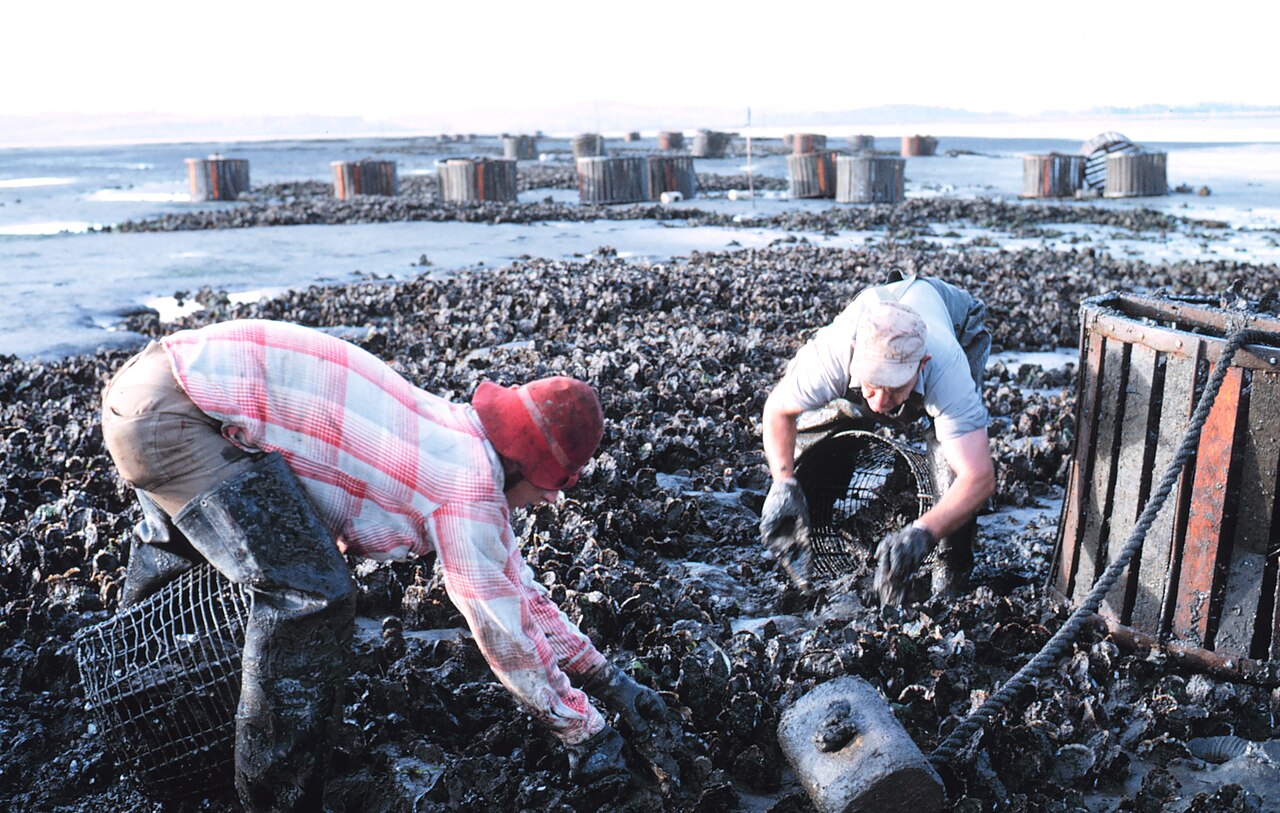
Oysters in bags or baskets need maintenance as they grow. Mussels on ropes need suitable attachment, support and exchange. Burrowing clams need an appropriate bed; NOAA's marine aquaculture technical guide discusses in-bottom culture. Treating these animals as identical because all are shellfish can produce unsuitable equipment choices.
Fouling, crowding and damaged gear can reduce the useful environment. Maintenance should have a clear animal-care purpose and be performed without unnecessary rough handling. The farm should be serviceable in the conditions when work is actually required, not only during a calm demonstration.
Let the competent authority determine harvest status
Use the growing-area classification and current harvest conditions for the specific location and product. The responsible authority's programme combines information that an individual grower cannot replace with a quick water sample. Requirements vary, so avoid applying a foreign programme as if it were local authorization.
If a closure, pollution event or other restriction applies, follow the official response. Do not move stock or product into another area as an improvised workaround. Such movement can create additional animal-health, environmental and food-safety issues.
The useful preparation is knowing which authority provides the status and how the farm receives urgent changes. That connection enables a prompt decision without turning daily production into a collection of unrelated administrative tasks.
Harvest and temperature control preserve the product
Prepare clean equipment, appropriate containers and the intended temperature-controlled route before harvest starts. Avoid unnecessary heat exposure, contamination from dirty surfaces and delays while transport is arranged. The quality of a long growing period can still be undermined in a short handling period.
Washington State's shellfish handling guidance explains why proper handling and cooking matter and why biotoxins require a different understanding. Its recreational instructions are not a substitute for a commercial programme, but the distinction between microbial risks and toxin risks is important.
Do not assume that rinsing, freezing or cooking makes every unsuitable product safe. Treatments have limits. Likewise, purification or relaying is a controlled process with defined applications, not an informal instruction to place questionable shellfish in a container of cleaner-looking water.
Respond to animal mortality separately
Unexplained losses deserve an aquatic-health investigation. Inspect the animals, gear and environment and obtain appropriate specialist support. Heat, salinity changes, handling injury and infection can require different responses. A single dead shell cannot establish what happened to the crop.
Maintain the separation between that investigation and the decision to release food for sale. Waiting for a named animal diagnosis is not a reason to ignore a harvest restriction, and a reassuring animal examination does not replace the applicable food-safety controls.
Do normal-looking shellfish prove the water is suitable for harvest?
No. The animals can accumulate hazards that are not visible. Use the applicable growing-area and harvest controls.
Does cooking remove every shellfish hazard?
No. Appropriate cooking addresses some microbial risks, but natural toxins and chemical contaminants cannot be assumed to disappear. The first protection is a suitable harvest source and competent handling.
Animal references
Cite this reference
LivestockDefense. “Shellfish growing water and harvest safety: oysters, mussels and clams.” Updated 2026-11-02. https://livestockdefense.com/guides/shellfish-growing-water-and-harvest-safety/
Add the date you accessed the page. This identifies the current reference; keep a permitted saved copy if your work depends on its exact wording. A citation alone does not establish support for a claim.
How to cite a page and its revision ↗Sources & boundaries
Read the evidence in context.
These documents support the statements identified in this reference. Check their scope and dates when deciding whether they answer your question.
- NOAA Fisheries: Pacific oyster aquaculture
Source update: Not provided. Most recent check: 2026-11-02.
Bounded species biology, feeding context and production or husbandry statements attributed to this document in the animal overview sections. No numerical feeding, medication, restraint or breeding protocol reproduced.
- NOAA Fisheries: Blue mussel biology and aquaculture
Source update: Not provided. Most recent check: 2026-11-02.
Species biology, life stages and the bounded practical husbandry facts cited in the aquatic animal overview or supporting guide; no drug dose, invasive procedure, universal stocking rate or complete clinical protocol.
- NOAA: Technical guide to marine aquaculture: clam aquaculture
Source update: Not provided. Most recent check: 2026-11-02.
Species biology, life stages and the bounded practical husbandry facts cited in the aquatic animal overview or supporting guide; no drug dose, invasive procedure, universal stocking rate or complete clinical protocol.
- Canadian Food Inspection Agency: Hazards that present a risk of contamination of live shellfish
Source update: Not provided. Most recent check: 2026-11-02.
Species biology, life stages and the bounded practical husbandry facts cited in the aquatic animal overview or supporting guide; no drug dose, invasive procedure, universal stocking rate or complete clinical protocol.
- Washington State Department of Health: Shellfish handling, storing and cooking
Source update: Not provided. Most recent check: 2026-11-02.
Species biology, life stages and the bounded practical husbandry facts cited in the aquatic animal overview or supporting guide; no drug dose, invasive procedure, universal stocking rate or complete clinical protocol.
- NOAA Fisheries: Understanding shellfish aquaculture
Source update: Not provided. Most recent check: 2026-11-02.
Species biology, life stages and the bounded practical husbandry facts cited in the aquatic animal overview or supporting guide; no drug dose, invasive procedure, universal stocking rate or complete clinical protocol.