
This reference uses the specific documents linked in the article and listed below. Check their scope, publication dates and the statements they support.
A bird may lose substantial weight before the problem is obvious
Feathers can hide severe loss of body tissue. Affected birds may lag behind flockmates, feel unexpectedly light when handled and become progressively less active. Reduced egg production or poor weight gain may be noticed before a clear cause is apparent.
Merck Veterinary Manual describes the characteristic chronic wasting and granulomas in multiple tissues. Although an owner may first present one affected bird, the exposure concern can involve the wider flock and its environment.
Progressive weight loss requires assessment rather than assuming that a bird is simply old or low-ranking. Check whether it can reach food and water and whether parasites, oral disease or another condition is limiting intake. A bird with severe wasting has little reserve for further illness.
Avian tuberculosis differs from familiar mammalian tuberculosis
The poultry disease is predominantly associated with M avium avium. The Merck overview of animal tuberculosis distinguishes M avium complex from the M tuberculosis complex responsible for important mammalian forms.
This distinction prevents misleading assumptions about symptoms and human risk. An affected chicken need not show the chronic cough commonly associated with human pulmonary tuberculosis. Intestinal and disseminated tissue disease are central to the poultry presentation.
Other mycobacteria can cause disease in birds, particularly in different captive-bird settings. Laboratory identification is therefore more informative than applying the same broad label to every acid-fast organism or every pale internal nodule.
Granulomas disrupt normal organs
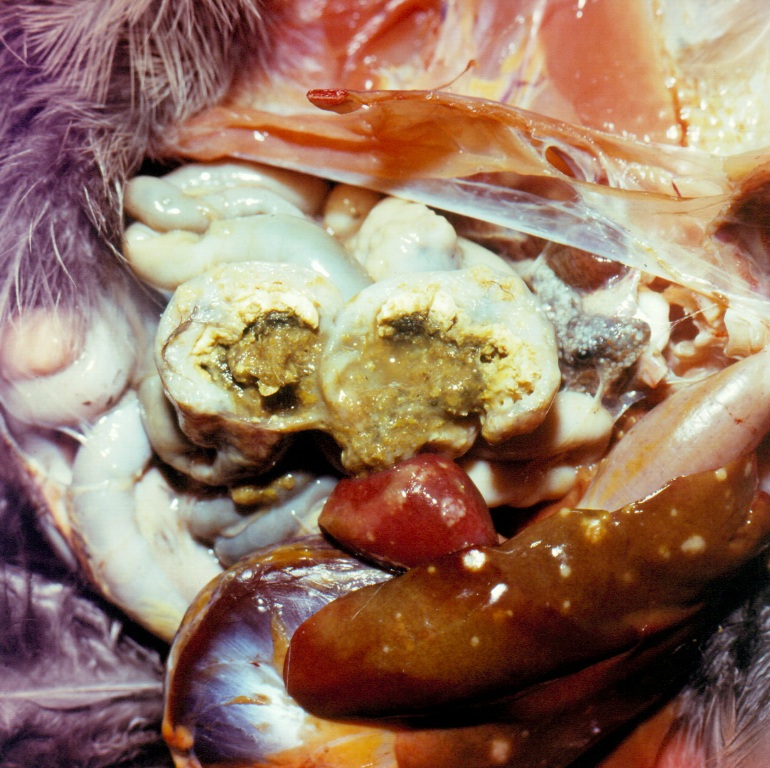
After exposure, bacteria can persist within immune cells and produce granulomatous inflammation. Intestinal lesions may impair normal function, while spread can involve the liver, spleen and bone marrow. White or pale firm masses may be seen at professional postmortem examination.
These lesions help explain the gradual loss of condition, but they are not unique enough for a photograph-based diagnosis. Marek's disease, avian leukosis and several bacterial diseases can also produce masses or abnormal internal organs.
The veterinarian needs to establish the nature of the lesions and identify the organism. Owners should not open carcasses or handle internal nodules in an attempt to confirm tuberculosis themselves.
Susceptibility varies between bird species
Chickens, pheasants and partridges are among the more susceptible birds described in the cited poultry reference. Turkeys are less susceptible, while ducks and geese appear relatively resistant. Relative resistance is not the same as an assurance that infection is impossible.
The disease is encountered particularly in some small, longer-lived or game-bird flocks rather than being an inevitable feature of commercial poultry. A long residence on contaminated ground can increase opportunities for exposure. Management history therefore matters alongside species.
The chicken, pheasant and turkey references provide broader husbandry context. A mixed collection should be assessed as a connected exposure setting rather than assuming the visibly ill species is the only one of concern.
Live-bird tests have important limits
Professional diagnosis often becomes clearest after postmortem examination. Histology and appropriate acid-fast examination can demonstrate compatible organisms, while molecular identification or other laboratory methods help confirm their identity.
Live-bird antibody and skin tests are not reliably definitive in poultry. Fecal molecular testing can be complicated by intermittent shedding. A single negative result therefore cannot necessarily clear a bird or flock, and a positive result needs the relevant clinical interpretation.
Discuss the testing objective with the veterinarian: diagnosing one wasting bird, assessing exposed flockmates and evaluating a property are different questions. The laboratory should direct suitable submission, and owners should avoid improvised specimen collection or home culture.
Treatment is usually an unrealistic poultry-control strategy
The cited Merck poultry guidance does not recommend treatment. Prolonged therapy is unlikely to provide dependable success, and it does not solve the contaminated-premises problem. A brief antibiotic course is not a plausible cure for established avian tuberculosis.
An affected bird still deserves immediate welfare attention. Provide accessible feed and water and protection from aggression while the veterinarian assesses it. Advanced wasting, inability to feed or persistent distress may make humane euthanasia appropriate.
Do not move suspect birds to another home, sell them as apparently recovered or use treatment to bypass a flock-control decision. Depopulation, where considered, requires a specific veterinary and animal-health plan rather than an improvised response by the owner.
Contaminated ground can remain a problem for years
M avium can persist in soil for long periods. Fecal shedding adds contamination over time, so removing a visibly sick bird does not necessarily remove the exposure. Thorough cleaning can reduce bacterial load without reliably eliminating the organism.
Do not immediately restock affected pens with poultry, pigs or another susceptible species. The veterinarian can help assess the site, the practical limits of decontamination and whether an alternative location is needed. A brief empty period should not be treated as proof of freedom from infection.
Biosecurity remains useful for reducing introduction and movement of contamination. Equipment, litter and soil should not be carried casually from an affected area into clean facilities. Prevention works best before persistent environmental contamination develops.
Human exposure deserves proportionate care
M avium can infect people, although the types commonly associated with human disease differ from those predominating in birds. It is inaccurate to equate every poultry case with the familiar pattern of contagious human pulmonary tuberculosis, but ignoring exposure is also inappropriate.
Use careful hand hygiene and appropriate protection when dealing with suspect birds and contaminated material. Vulnerable people should avoid unnecessary contact and seek medical advice when relevant. Anyone with illness after exposure should tell a healthcare professional about the bird diagnosis.
The zoonoses collection supplies broader shared-health context. Professional identification helps make both animal and human advice more specific than the word tuberculosis alone.
Can one sick bird indicate a wider flock problem?
Yes. The first recognizable case may be an individual even when other birds share the contaminated environment.
Will a negative fecal result prove that a bird is clear?
No. Intermittent shedding can limit interpretation.
Is a short course of antibiotics a reliable solution?
No. Treatment is generally not recommended in poultry and does not resolve persistent premises contamination.
Cite this reference
LivestockDefense. “Avian tuberculosis in poultry: wasting, diagnosis and control.” Updated 2026-11-02. https://livestockdefense.com/threats/avian-tuberculosis-in-poultry/
Add the date you accessed the page. This identifies the current reference; keep a permitted saved copy if your work depends on its exact wording. A citation alone does not establish support for a claim.
How to cite a page and its revision ↗Sources & boundaries
Read the evidence in context.
These documents support the statements identified in this reference. Check their scope and dates when deciding whether they answer your question.
- Merck Veterinary Manual: Tuberculosis in poultry
Source update: 2024-03. Most recent check: 2026-11-02.
Poultry M avium disease, tissue lesions, diagnostic limitations, environmental persistence and treatment/control context. No culture or tuberculin procedures reproduced.
- Merck Veterinary Manual: Overview of tuberculosis in animals
Source update: 2023-03. Most recent check: 2026-11-02.
Taxonomic distinction between M tuberculosis complex and M avium complex, host context and general granulomatous disease; mammalian clinical protocols are not extrapolated to poultry.