
This reference uses the specific documents linked in the article and listed below. Check their scope, publication dates and the statements they support.
The disease affects small blood vessels, not just the tongue
Vascular injury helps explain the combination of swelling, hemorrhage, painful mouth lesions and inflammation around the hoof. An animal may be reluctant to walk because its feet hurt, reluctant to eat because its mouth is painful, or breathless because the illness affects more than the visible tissues. Mechanism and clinical effects of bluetongue.
The name can be misleading. Many affected animals never develop a visibly blue tongue. Waiting for that finding can delay advice for a sheep with fever, facial swelling and sudden lameness. Conversely, a discolored tongue does not by itself identify the virus.
Clinical severity varies with the host and virus involved. Sheep are often particularly affected, while infection in cattle or goats can be mild or inapparent. Clinical disease in cattle nevertheless occurs; an apparently quiet cattle group does not prove that local ruminants have not been exposed. Species differences and silent infection.
Biting midges explain much of the exposure pattern
Culicoides midges carry the virus between susceptible animals. Weather, vector species and local ecology influence transmission, so a risk calendar from a different region is not a reliable guide. Windborne vectors and animal movement can change where exposure occurs.
This is primarily a vector-borne disease rather than an ordinary infection spread by casual contact between animals. However, that does not mean moving an infected animal is inconsequential: it can connect the virus with competent vectors elsewhere. Veterinary and animal-health movement advice matters even when the animal appears clinically normal. Vector-associated transmission context.
Do not assume that the first sick sheep on a farm identifies the precise place or date of infection. Affected groups may differ in susceptibility, and infection can precede visible illness.
Signs that need prompt attention
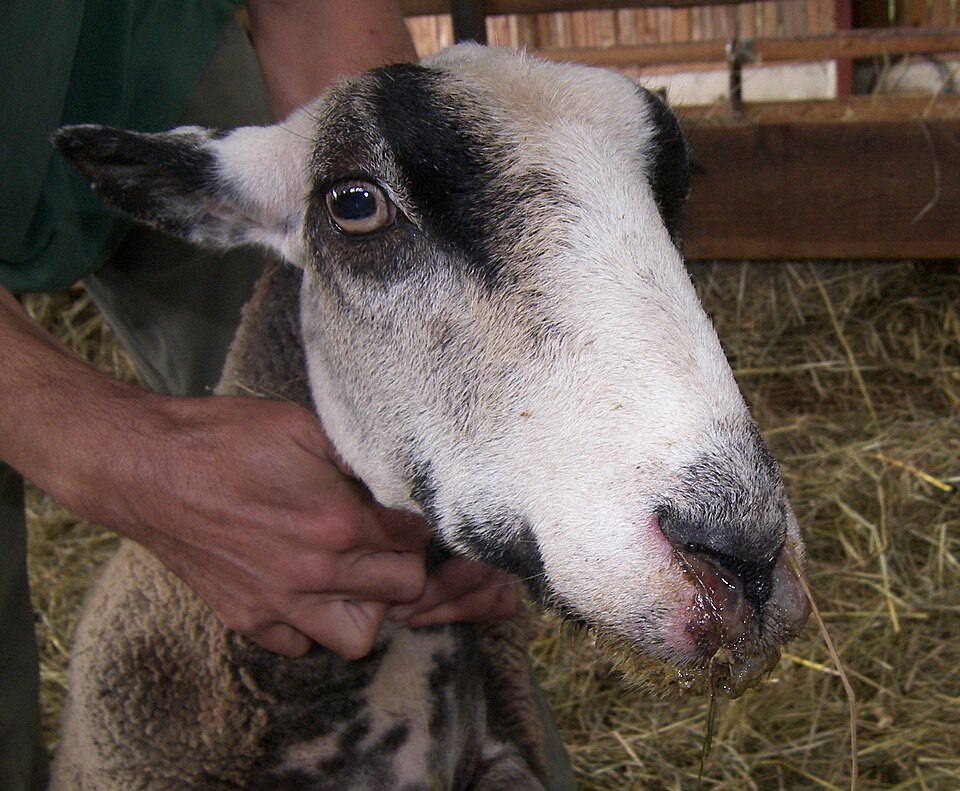
Fever, dullness, excess saliva, mouth erosions, swollen lips or face and inflammation at the hoof coronet are important clues. Severe respiratory effort, inability to swallow normally, recumbency or marked loss of intake requires urgent help. Handle affected animals quietly and avoid forcing a lame or breathless group through unnecessary movement.
Mouth disease with lameness overlaps with foot-and-mouth disease and other important infections. Orf can cause conspicuous mouth scabs, while epizootic hemorrhagic disease can resemble bluetongue in relevant hosts. These comparisons guide investigation; they do not diagnose a case from a photograph.
If an unusual mouth-and-foot or systemic disease pattern appears, contact the veterinarian promptly and obtain local animal-health advice before moving animals. The relevant reporting and movement rules depend on the jurisdiction and current situation. Official recognition and reporting guidance.
Pregnancy and recovery can reveal effects beyond the initial fever
Some infections during pregnancy can cause fetal loss or congenital abnormalities. The outcome depends on timing and the virus involved, so an abnormal newborn does not establish bluetongue without investigation. Conversely, a dam may have had little obvious illness when fetal damage occurred. Reproductive and congenital effects.
Survivors may need time to regain intake and condition. Hoof discomfort, mouth injury, muscle damage or secondary infection can prolong the practical consequences after the fever subsides. Wool growth and reproductive performance may also be affected.
Assess what the animal can actually do: walk to feed, eat, drink and care for offspring. An animal still losing condition after the apparent acute phase needs reassessment rather than being assumed recovered because a few visible lesions have healed.
Confirmation needs more than a compatible sign
The veterinarian combines the clinical pattern with laboratory testing for viral material or antibodies as appropriate. Those tests answer different questions. Antibodies indicate an immune response and may reflect previous infection or vaccination; they do not automatically date the current illness. Agent detection is interpreted with timing and clinical context.
Identifying the relevant serotype can inform control and vaccination. There are multiple serotypes, and protection against one cannot simply be assumed to cover every other one. Professional diagnostic coordination is therefore more useful than an undifferentiated label of “orbivirus positive.” Diagnostic interpretation and virus variation.
Do not undertake farm tissue collection or attempt an unvalidated rapid diagnosis. A sick animal needs clinical support while the appropriate diagnostic and official arrangements are made.
Care is supportive and directed at the actual complications
There is no routine specific antiviral cure. Rest, accessible water and feed suitable for a painful mouth are central practical measures. A veterinarian may provide pain relief, fluid support or treatment of secondary complications according to the animal’s findings. Antibiotics do not directly eliminate the virus. Supportive care and recovery.
Do not force fluids into an animal with impaired swallowing or repeatedly drive a sheep with painful feet. A recumbent or severely breathless animal needs a realistic welfare and prognosis assessment. Mild and severe cases should not receive the same expectation of recovery.
Vaccination must match the problem
An appropriate vaccine can reduce disease, but product choice must reflect the relevant serotype, local authorization and the animal’s class and pregnancy status. Live and inactivated products have different restrictions. Use current veterinary and official guidance rather than a product list copied from another country or an older outbreak. Current local vaccination and control guidance.
Reducing midge exposure can help but does not guarantee prevention or stop an outbreak by itself. Measures should fit the species, housing and local vector conditions and use authorized products correctly. Routine contact hygiene remains good husbandry, but cannot replace a vector-aware plan.
Can people catch bluetongue?
Bluetongue is not a human infection. That reassurance does not override food-chain or movement instructions for a sick animal.
Does a normal-looking herd need no attention after nearby cases?
No. Silent infection and changing local control requirements can matter. Use current local advice and the sheep, cattle and goat hubs for related animal-care context.
Cite this reference
LivestockDefense. “Bluetongue in livestock: mouth lesions, lameness, reproduction and prevention.” Updated 2026-11-02. https://livestockdefense.com/threats/bluetongue/
Add the date you accessed the page. This identifies the current reference; keep a permitted saved copy if your work depends on its exact wording. A citation alone does not establish support for a claim.
How to cite a page and its revision ↗Sources & boundaries
Read the evidence in context.
These documents support the statements identified in this reference. Check their scope and dates when deciding whether they answer your question.
- Merck Veterinary Manual: Bluetongue in ruminants
Source update: 2025-04. Most recent check: 2026-11-02.
Vascular injury, mouth/foot/respiratory signs, supportive care and vaccine matching. No viral structure, specimen preservation, growth or inoculation methods reproduced; no universal mortality or serotype count.
- World Organisation for Animal Health: Bluetongue
Source update: Not provided. Most recent check: 2026-11-02.
Ruminant host range, predominantly midge-mediated spread, variable clinical disease and lack of human infection. Inconsistent historical serotype counts and absolute transmission wording not adopted.
- Iowa State University Center for Food Security and Public Health: Bluetongue
Source update: 2023-10. Most recent check: 2026-11-02.
Clinical variation, congenital/reproductive outcomes, diagnostic context and control limitations. Historical geographic/vaccine availability not treated as current local law; no agent handling or chemical recipes.
- Defra / Animal and Plant Health Agency: Bluetongue: how to spot and report it
Source update: Not provided. Most recent check: 2026-11-02.
Recognition, reproductive/production effects and jurisdiction-specific contact with animal-health authorities. Live zone, case counts, movement permissions and vaccine approvals not copied into evergreen article.