
This reference uses the specific documents linked in the article and listed below. Check their scope, publication dates and the statements they support.
Scabs are visible, but pain determines the immediate care
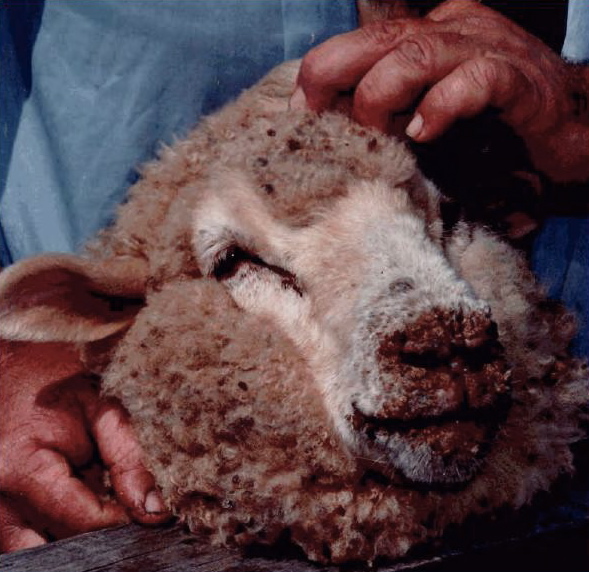
Orf lesions often develop where skin is abraded, especially around the lips and muzzle. Thick crusts can make the disease conspicuous, but the important practical question is whether the animal can eat and nurse. A lamb or kid may repeatedly approach the teat yet fail to obtain enough milk because suckling hurts. Clinical effects of contagious ecthyma.
Adult lesions on the teats can make a dam reluctant to allow suckling. Youngstock and mother therefore need to be assessed together. A hungry newborn beside a full udder may have a feeding problem that is not obvious from the size of its mouth scab.
Lesions near the coronary band can contribute to lameness, and other skin sites may be affected. Do not assume that every foot lesion in a flock with orf is caused by the virus; separate hoof disease or secondary infection may be present. Sites and complications of ecthyma.
Why infection can persist between lambing groups
Lesions and contaminated scabs spread infection through contact, including contact with damaged skin. Equipment and the environment can help maintain exposure. A pen that looks empty is not automatically free of contamination once an infected group has left. Animal contact and contaminated-environment exposure.
Reduce avoidable abrasions from sharp feeders or abrasive forage, and consider where young animals press their faces when feeding. That does not guarantee prevention, but it removes a potential entry opportunity while improving comfort.
Separate clinically affected groups where practical and protect clean feeding equipment. Staff should avoid carrying contamination from affected animals to susceptible newborns on hands, clothing or shared tools. Repeatedly picking at a scab to see whether it is healing is unnecessary and can spread material.
Mouth sores are not automatically orf
The veterinarian considers the lesion pattern and the rest of the animal’s condition. Widespread mouth disease accompanied by fever, marked salivation, lameness, diarrhea, respiratory signs or high mortality broadens concern beyond ordinary sore mouth. Peste des petits ruminants, bluetongue and foot-and-mouth disease are important comparisons in the appropriate setting. Major differential diagnoses.
Do not move animals with an unusual contagious mouth-disease pattern while arranging advice. The veterinarian can determine whether local animal-health authorities need to be involved. An international disease list does not diagnose a farm outbreak, but neither should familiarity with orf dismiss an unexpected pattern.
PCR or other appropriate diagnostic work can confirm an uncertain case. The useful outcome is a diagnosis that fits both the lesions and the flock’s clinical course, rather than the assumption that any crust around a mouth has the same cause.
Support feeding and treat complications
There is no specific routine antiviral cure. Care focuses on comfort, adequate intake and secondary problems. A veterinarian may prescribe pain relief or treatment for bacterial infection where indicated. Antibiotics do not directly cure the virus and should not be treated as a standard answer to every uncomplicated scab. Treatment principles.
Offer feed and water the animal can use comfortably and assess whether youngstock are actually nursing. A weak, dehydrated or persistently hungry lamb or kid needs prompt support. Assisted feeding, where needed, must suit the animal’s swallowing ability and be directed by someone trained in the method.
Monitor affected udders and feet as well as the mouth. Mastitis, severe lameness, flystrike or extensive lesions can change the prognosis and care required. An animal whose intake or general condition is worsening should be re-examined even if the skin initially looked typical.
Recovery does not make the farm permanently protected
Many uncomplicated lesions heal, but severe or persistent disease occurs and repeat infection is possible. Do not promise that one episode confers lifelong sterilizing immunity or that the disappearance of scabs proves the environment is clear. Immunity and continuing control limitations.
Continue appropriate separation and hygiene through recovery as advised. Reassess an animal with unusually proliferative lesions, poor growth or other illness; a normal-looking healing timetable is not a reason to ignore an individual that is failing to thrive.
Live vaccination needs a reason and a plan
Available orf vaccines contain live virus and can introduce infection into a susceptible setting. They are generally considered for flocks with a relevant disease problem, under veterinary and product-label guidance. Vaccinating every disease-free flock as a precaution can create the very contamination it is intended to prevent. Planning orf vaccination.
Vaccine use must account for the flock’s lambing pattern, susceptible animals, administration precautions and local authorization. Maternal vaccination should not be assumed to provide complete colostral protection for lambs. Do not improvise live-virus exposure from scabs or an infected animal as a substitute for an authorized program.
Protect hands and explain exposures to a clinician
Orf can cause painful human skin lesions, often on hands after handling affected sheep or goats. Wear gloves, cover skin breaks and wash after animal care. The live vaccine also poses an exposure risk and requires its own handling precautions. Occupational exposure precautions.
Anyone developing a concerning skin lesion should seek medical advice and mention animal contact, rather than assuming it is harmless or treating it as an ordinary blister.
Should the scabs be pulled off?
Routine removal is unnecessary and can cause pain and spread contaminated material. Let the veterinarian assess lesions that obstruct feeding or have unusual complications.
Is orf the same as sheep pox or goat pox?
No. Sheep pox and goat pox are different infections. Explore the sheep and goat hubs for related conditions.
Cite this reference
LivestockDefense. “Contagious ecthyma: orf, sore mouth and caring for affected sheep and goats.” Updated 2026-11-02. https://livestockdefense.com/threats/contagious-ecthyma/
Add the date you accessed the page. This identifies the current reference; keep a permitted saved copy if your work depends on its exact wording. A citation alone does not establish support for a claim.
How to cite a page and its revision ↗Sources & boundaries
Read the evidence in context.
These documents support the statements identified in this reference. Check their scope and dates when deciding whether they answer your question.
- Merck Veterinary Manual: Contagious ecthyma in sheep and goats
Source update: Not provided. Most recent check: 2026-11-02.
Proliferative/scabby mouth, teat and foot lesions, clinical differentials, supportive care and secondary infection. No virus propagation, deliberate infection or vaccine application procedure reproduced.
- Iowa State University Center for Food Security and Public Health: Contagious ecthyma
Source update: 2023-08. Most recent check: 2026-11-02.
Painful cutaneous disease, animal feeding implications, prolonged environmental contamination and limits of vaccine/clinical immunity. No infectious dose, laboratory procedure or environmental survival parameters reproduced.
- Virginia Tech: Contagious ecthyma (orf) fact sheet
Source update: Not provided. Most recent check: 2026-11-02.
Lesion locations and human skin inoculation/contaminated equipment precautions. No unsupported certainty that all lesions resolve without veterinary or medical assessment.
- AHDB: Orf vaccination in sheep
Source update: Not provided. Most recent check: 2026-11-02.
Live vaccine must be a specific flock-risk decision with local label precautions, rather than automatically introduced into a disease-free flock. No scarification or live-virus administration procedure reproduced.