
This reference uses the specific documents linked in the article and listed below. Check their scope, publication dates and the statements they support.
Animal at a glance
| Topic | Overview |
|---|---|
| Animal group | Several distinct freshwater fish species occur in carp production |
| Production roles | Food fish and seed for single-species or polyculture systems |
| Life stages | Broodstock, fry, fingerling and food-fish grow-out |
Common carp are not every kind of carp
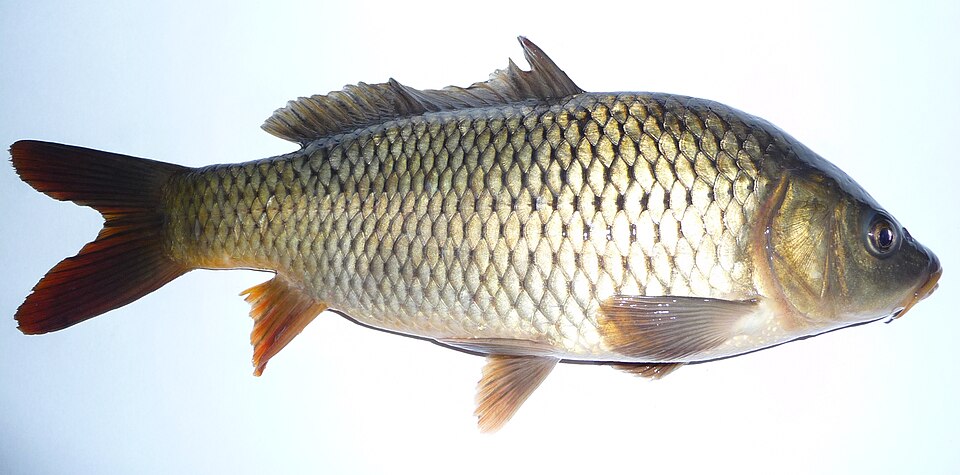
Common carp, Cyprinus carpio, differ from grass carp, silver carp and bighead carp. The names matter because the animals use different feeding niches. A management example for common carp cannot simply be applied to a grass-carp pond or a mixed-species enterprise. FAO's common carp profile describes the biology and culture of this particular species.
Common carp forage near the bottom and can also take food higher in the water. Their ability to use a broad range of foods helps explain their long history in pond culture. It does not mean they thrive on an unlimited quantity of whatever material is available. Food quality and the pond's capacity still constrain growth.
Understand the pond food web
Carp ponds can combine natural productivity with supplemental feeding. FAO's pond-fish culture guidance distinguishes species and systems rather than presenting one universal pond recipe. In a mixed-species pond, the intended benefit comes from matching fish to available food resources. Merely adding more species can create competition or management difficulties instead.
For a new operator, the useful question is what each stocked species is expected to eat. If several fish depend on the same scarce food, diversity alone will not increase the pond's carrying capacity. If one species grows well while another remains small, the feeding niches, seed quality and access to feed deserve attention before stocking is increased.
Observe the water and the fish together. A heavily productive pond may look green yet still become short of oxygen during part of the daily cycle. Water color cannot tell the farmer everything about food availability, waste accumulation or animal welfare.
Feeding without overloading the pond
Choose supplemental feed for the species, fish size and culture method. Common carp can use cereals in some established pond systems, but that is not a justification for substituting grain for a balanced diet in every intensive unit. A feed decision should account for what the pond already supplies and what the fish need for the intended growth stage.
Distribute feed where it can be used without persistent accumulation. When appetite drops, check the environment and animal health before increasing the ration. Leaving more material on the bottom does not solve a feeding problem and can make its consequences harder to manage.
A practical feeding review includes pellet or particle size, storage quality and access. Small fish may be present in the pond but unable to use feed supplied for larger stock. A mixed-size population can therefore need a different approach from a uniform nursery group.
Seed, spawning and nursery stages
Common carp production may begin with a specialist hatchery or managed spawning operation. Eggs, newly feeding fry and larger juveniles are different husbandry stages. The feed available to market-size carp is not a substitute for suitable first food for fry.
Buying reliable nursery fish can be a sound choice for a grow-out enterprise that lacks hatchery expertise. Before purchase, check that the fish are appropriate to the local production season and the receiving water. Arrange acclimation and unloading with the supplier or technical adviser so that a transport success is not followed by preventable placement losses.
Avoid mixing seed sources casually. A new introduction changes the health exposure of the existing stock as well as the number of fish competing for resources. Suitable health assurance and separation of incoming stock should be designed with local aquatic-health support.
Seasonal care and handling
Common carp can survive cool periods, but survival and useful growth are different outcomes. Plan around the actual local growing season rather than copying harvest expectations from a warmer region. Feeding decisions should follow the condition and appetite of the fish and the ability of the pond to process the input.
During netting and harvest, reduce unnecessary time under crowding or poor water exchange. Use surfaces and equipment that limit scale loss and skin damage. Fish that appear resilient in the pond can still be injured by a rushed handling operation.
Repeated deaths, abnormal swimming, skin lesions or a sudden change in appetite call for an environmental and fish-health investigation. Do not assume that every carp problem is koi herpesvirus, a parasite or a simple feed deficiency. Similar outward signs can have different causes.
Questions growers commonly ask
Can common carp and grass carp receive identical feeding advice?
No. They are distinct fish with different feeding biology. A shared common name or a shared pond does not make their nutritional role identical.
Does a larger pond always support more production?
Not in direct proportion to its area. Water supply, depth, food production, oxygen conditions, management access and harvest design all affect what the pond can support. A workable production plan considers these constraints before selecting stock numbers.
Continue with practical guidance
Field guides for this animal
Browse all Carp field guides for husbandry advice, health explanations and practical farm routines.
Cite this reference
LivestockDefense. “Carp farming: species, pond food, feeding and seasonal care.” Updated 2026-11-02. https://livestockdefense.com/animals/carp/
Add the date you accessed the page. This identifies the current reference; keep a permitted saved copy if your work depends on its exact wording. A citation alone does not establish support for a claim.
How to cite a page and its revision ↗Sources & boundaries
Read the evidence in context.
These documents support the statements identified in this reference. Check their scope and dates when deciding whether they answer your question.
- FAO: Pond culture: cultivated species and systems
Source update: Not provided. Most recent check: 2026-11-02.
Bounded production identity and species context cited in the global livestock hubs. Practical examples are editorial suggestions. Historical sources do not establish current local market permissions or clinical protocols.
- FAO: Common carp cultured species fact sheet
Source update: Not provided. Most recent check: 2026-11-02.
Bounded species biology, feeding context and production or husbandry statements attributed to this document in the animal overview sections. No numerical feeding, medication, restraint or breeding protocol reproduced.