
This reference uses the specific documents linked in the article and listed below. Check their scope, publication dates and the statements they support.
Feed is an input to an ecosystem
Only part of a feed input becomes harvested animal tissue. The rest affects the production environment through waste, uneaten material and the organisms that process it. Mississippi State's catfish water-quality guidance explains this relationship in fed ponds. The exact balance differs among systems, but the practical question is the same: can the environment process what the farm is putting into it?
A feeding plan should therefore be checked against oxygen delivery and waste management. Increasing the ration without reviewing those limits can create a system problem even if the feed itself is nutritionally suitable. The biggest fish are not the only living things using oxygen in the unit.
Match the ration to the animal and stage
Choose a feed developed for the actual species and size. Catfish, trout, tilapia and shrimp should not be grouped into one nutritional prescription. Mississippi State's catfish nutrition resources provide a species-specific example of why feed form and stage matter.
Particle size and behavior can be as important as the label. A fish must be able to capture and swallow the pellet. A bottom-associated prawn must be able to reach appropriate food without losing most of it elsewhere. Feed that drifts out of a cage or crumbles before consumption is not a ration successfully delivered.
Storage is part of nutrition. Protect the product from moisture, excessive heat and pests and use it within its stated storage guidance. Do not assume that a detailed feeding calculation compensates for a damaged or unsuitable ingredient supply.
Appetite is a signal, not a command to add more
Watch how animals respond across the unit. A few active individuals can conceal a larger group feeding poorly. Changes may reflect temperature, oxygen, stress, handling, illness or the food itself.
When appetite declines abruptly, pause the assumption that the planned ration must be delivered regardless. Check operation of pumps, aeration and feeders, assess the water and seek advice if the cause is unclear. More uneaten food can intensify the original problem.
The response must fit the animal. FAO's tilapia profile, trout profile and shrimp profile describe different species and stages. A feeding decision borrowed from one should not become a universal rule for the others.
Oxygen supply has to match demand where animals live
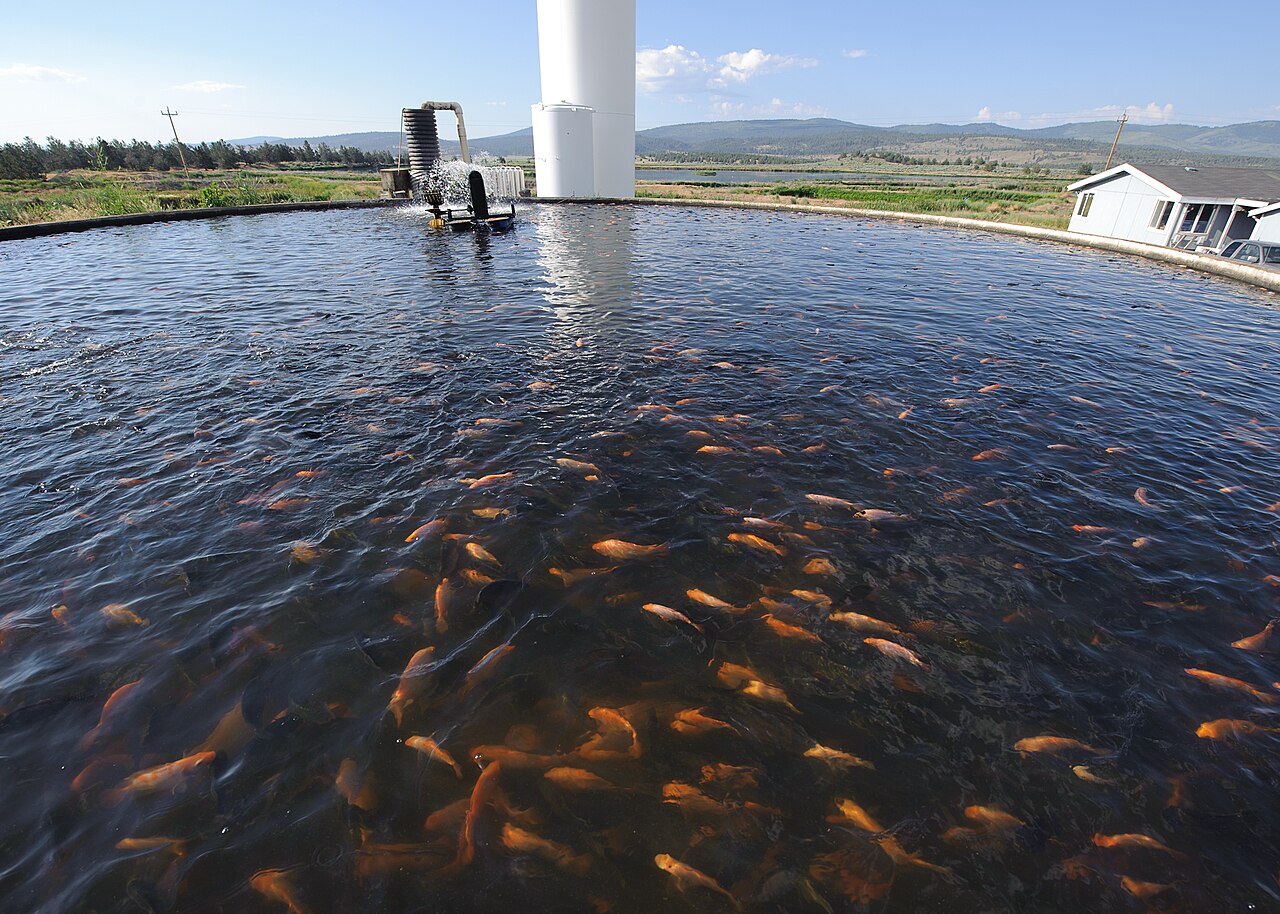
A pond can gain oxygen during photosynthesis and lose it through respiration. A recirculating tank depends more directly on its designed life support. A cage relies on exchange with surrounding water. These differences determine where and when an operator should look for the limiting conditions.
New Mexico State University's aquaponics water-quality guide explains oxygen needs of both fish and the bacteria involved in waste conversion. The source is an aquaponics reference, so its example values should not be presented as universal limits for every farmed animal.
Assess the water reaching the stock rather than relying on visible surface agitation. A well-aerated corner does not guarantee suitable conditions behind a blocked screen or within heavily fouled gear. Growing biomass can also reduce the safety margin without any new stocking event.
Dissolved waste can matter even in clear water
The Merck aquatic environmental-disease review identifies oxygen shortage and ammonia as important hazards. Clear water is not a laboratory result. A facility can look clean while a dissolved substance or a life-support failure compromises the animals.
Waste management depends on the system: solids removal, biological treatment, water exchange or pond processes may each have a role. Equipment should be selected and maintained as a functioning chain. An excellent tank cannot compensate for a treatment stage that is too small or repeatedly unavailable.
Do not make abrupt chemical adjustments from a single unconfirmed result. Verify what was measured and obtain a system-specific response from a qualified adviser. The appropriate action depends on the water, stock and underlying failure, not only the number on a test device.
Plan for a failure before the animals depend on the equipment
List the operations that must continue: water movement, aeration, oxygen provision or treatment as applicable. Then check whether the backup arrangement can actually be started, supplied and operated safely. An unused generator with no workable connection is not a production safeguard.
New staff should know the first response to surface crowding, abnormal breathing or a sudden system alarm. An urgent event is the wrong time to decide who can authorize action or where essential equipment is stored. Keep the response practical and reachable.
When to involve an aquatic-health professional
Rapidly increasing deaths, unusual swimming, severe appetite loss or visible injury need prompt assessment. Environmental and infectious problems may occur together. Correcting water conditions can be necessary while a professional investigates another cause; it does not automatically prove the diagnosis.
Does clear water mean healthy water?
No. Oxygen and dissolved wastes are not reliably assessed by appearance. Use appropriate measurements interpreted for the actual species and system.
Is the largest recommended feed rate the best target?
No. A ration must fit appetite, life stage, stock condition and environmental capacity. Feeding beyond what the animals and system can use wastes resources and can undermine welfare.
Animal references
Cite this reference
LivestockDefense. “Aquatic feeding, oxygen and water quality: manage the whole production system.” Updated 2026-11-02. https://livestockdefense.com/guides/aquatic-feeding-oxygen-and-water-quality/
Add the date you accessed the page. This identifies the current reference; keep a permitted saved copy if your work depends on its exact wording. A citation alone does not establish support for a claim.
How to cite a page and its revision ↗Sources & boundaries
Read the evidence in context.
These documents support the statements identified in this reference. Check their scope and dates when deciding whether they answer your question.
- Merck Veterinary Manual: Environmental Diseases of Aquatic Animals in Aquatic Systems
Source update: 2026-06. Most recent check: 2026-10-30.
Document scope and recorded checks
Surface piping is compatible with low oxygen, and water-quality interpretation depends on species and system; no universal threshold, chemical correction or environmental manipulation recipe supplied. pH, carbonate conditions and other water variables need species- and system-specific interpretation; no chemical adjustment, sampling recipe or universal safe range supplied. Pond dissolved oxygen can vary across the day; water interpretation remains species- and system-dependent. No measurement protocol, threshold or corrective manipulation recipe supplied. Water-quality assessment matters and interpretation varies with species and system. No universal larval thresholds or corrective chemical procedures supplied. Nitrogenous compounds, pH and temperature need species/system context; rising pH can increase ammonia toxicity. No universal safe ranges, chemical correction, calculation recipe or test procedure supplied. Pond dissolved oxygen can vary over a day; water measurements require species/system and actual location/time context. No universal threshold, sampling schedule or water-correction procedure supplied.
Entries retain the date and scope of each recorded inspection.
- 2026-10-30 — Nitrogenous compounds, pH and temperature need species/system context; rising pH can increase ammonia toxicity. No universal safe ranges, chemical correction, calculation recipe or test procedure supplied.
Exact publisher page or indexed publisher text inspected for the bounded facts identified; no independent veterinary review implied
- 2026-10-30 — Pond dissolved oxygen can vary over a day; water measurements require species/system and actual location/time context. No universal threshold, sampling schedule or water-correction procedure supplied.
Exact publisher page or indexed publisher text inspected for the bounded facts identified; no independent veterinary review implied
- 2026-10-29 — Surface piping is compatible with low oxygen, and water-quality interpretation depends on species and system; no universal threshold, chemical correction or environmental manipulation recipe supplied.
Exact publisher page or indexed publisher text inspected for the bounded facts identified; no independent veterinary review implied
- 2026-10-29 — pH, carbonate conditions and other water variables need species- and system-specific interpretation; no chemical adjustment, sampling recipe or universal safe range supplied.
Exact publisher page or indexed publisher text inspected for the bounded facts identified; no independent veterinary review implied
- 2026-10-29 — Pond dissolved oxygen can vary across the day; water interpretation remains species- and system-dependent. No measurement protocol, threshold or corrective manipulation recipe supplied.
Exact publisher page or indexed publisher text inspected for the bounded facts identified; no independent veterinary review implied
- 2026-10-29 — Water-quality assessment matters and interpretation varies with species and system. No universal larval thresholds or corrective chemical procedures supplied.
Exact publisher page or indexed publisher text inspected for the bounded facts identified; no independent veterinary review implied
- 2026-10-30 — Nitrogenous compounds, pH and temperature need species/system context; rising pH can increase ammonia toxicity. No universal safe ranges, chemical correction, calculation recipe or test procedure supplied.
- FAO: Whiteleg shrimp cultured species fact sheet
Source update: Not provided. Most recent check: 2026-11-02.
Bounded species biology, feeding context and production or husbandry statements attributed to this document in the animal overview sections. No numerical feeding, medication, restraint or breeding protocol reproduced.
- FAO: Nile tilapia cultured species fact sheet
Source update: Not provided. Most recent check: 2026-11-02.
Bounded species biology, feeding context and production or husbandry statements attributed to this document in the animal overview sections. No numerical feeding, medication, restraint or breeding protocol reproduced.
- FAO: Rainbow trout cultured species fact sheet
Source update: Not provided. Most recent check: 2026-11-02.
Bounded species biology, feeding context and production or husbandry statements attributed to this document in the animal overview sections. No numerical feeding, medication, restraint or breeding protocol reproduced.
- Mississippi State University Extension: Catfish nutrition, feeds and feeding
Source update: Not provided. Most recent check: 2026-11-02.
Species biology, life stages and the bounded practical husbandry facts cited in the aquatic animal overview or supporting guide; no drug dose, invasive procedure, universal stocking rate or complete clinical protocol.
- Mississippi State University Extension: Catfish water quality
Source update: Not provided. Most recent check: 2026-11-02.
Species biology, life stages and the bounded practical husbandry facts cited in the aquatic animal overview or supporting guide; no drug dose, invasive procedure, universal stocking rate or complete clinical protocol.
- New Mexico State University Extension: Important water quality parameters in aquaponics systems
Source update: Not provided. Most recent check: 2026-11-02.
Species biology, life stages and the bounded practical husbandry facts cited in the aquatic animal overview or supporting guide; no drug dose, invasive procedure, universal stocking rate or complete clinical protocol.