
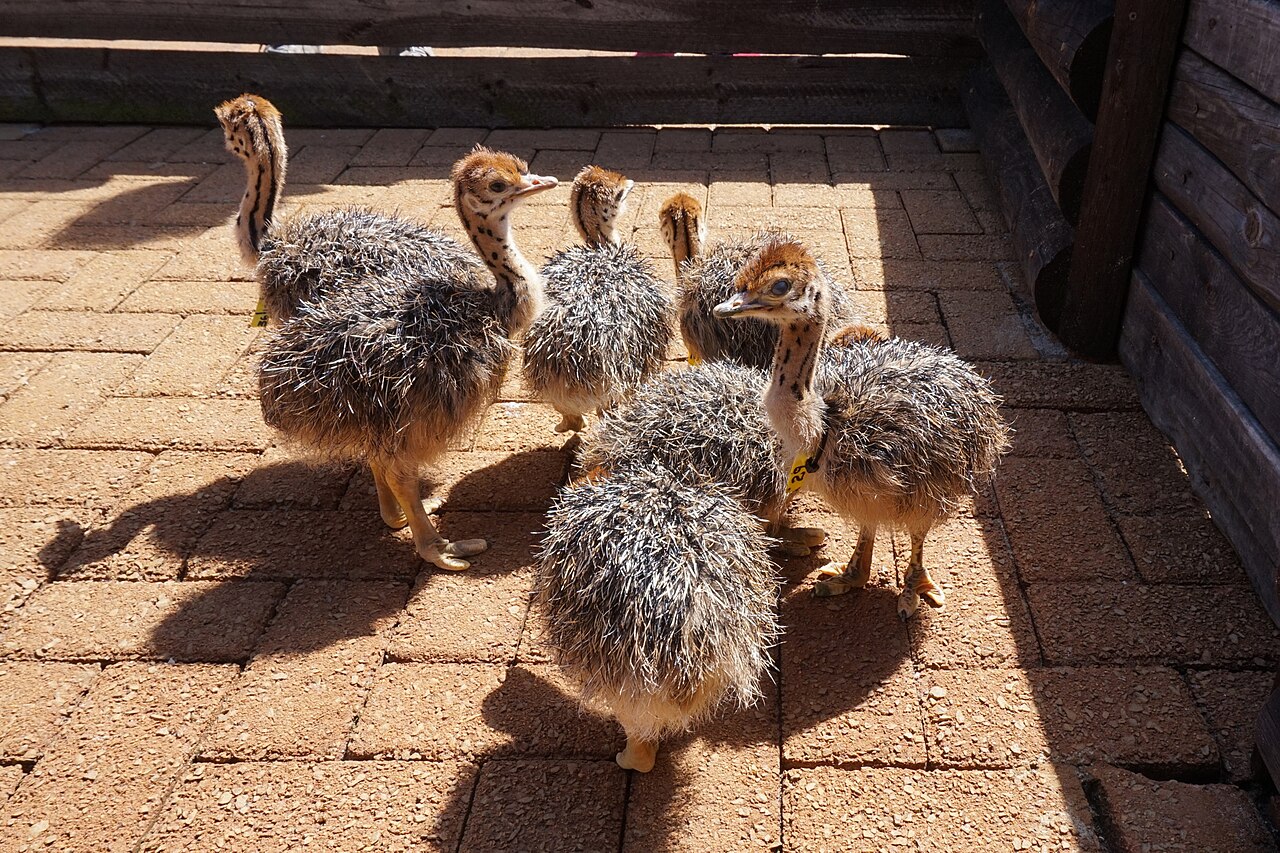
This reference uses the specific documents linked in the article and listed below. Check their scope, publication dates and the statements they support.
Start with the species and the growing stage
Ostriches, emus and rheas share the ratite label, but they do not have identical digestive systems or nutritional requirements. The MSD management chapter recommends appropriate formulated ratite feeds and distinguishes their feeding biology. Treat a feed label as a statement about the particular product and stage, rather than assume anything sold for poultry is interchangeable.
Have the feeding arrangement ready before chicks arrive. Ask the supplier which feed they have been eating and obtain advice on the next appropriate stage. A practical conversation with the feed manufacturer or nutritionist should cover the actual species, age range and intended product. A small mixed-age group can require more thought than a larger uniform group, because the birds may not all belong on the same ration.
Aim for sound growth rather than maximum speed
The Merck nutrition chapter explains that juvenile ratites need a different nutrient supply from maintenance adults and that breeders have their own requirements. It also links excessively rapid growth with angular leg deformities. Protein, minerals and energy should be considered as a balanced ration; adding one supplement does not reliably correct an unknown imbalance.
Do not treat a mature bird's roughage use as proof that a chick can thrive on the same diet. Equally, an adult breeder ration is not simply a more nutritious chick feed. Select the proper stage and seek qualified help with a formulation problem. Avoid stacking mineral products onto a complete ration without knowing what the combined diet supplies.
Make movement easy and footing secure
The Merck chick-management chapter emphasizes exercise, appropriate substrate, space, ventilation and sufficient feeders and drinkers. It identifies musculoskeletal problems as an important concern in growing ratites. An enclosure needs to let chicks walk normally, not merely hold them within a fence.
Look at the floor from chick level. Check slippery approaches to drinkers, cramped corners and awkward changes between surfaces. Provide a safe place to move without forcing birds to scramble over each other. Choose substrate with an experienced producer or veterinarian; the suitability of a material depends partly on how birds encounter it and how the enclosure is maintained. A surface that is easy to wash is not necessarily the best surface for developing legs.
Keep feeding areas free of hazards
Rutgers Cooperative Extension describes the changing feeding needs of growing ratites and the risk of chicks consuming unsuitable material. Feeding and enclosure management therefore belong together. Keep loose hardware, discarded twine and other foreign material out of the run, and assess any item the birds can reach as something they might investigate with their beaks.
Place feed and water where chicks can find and use them, with enough access to avoid a persistent crowd. A bowl that is present but difficult to reach does not solve a feeding problem. Inspect wet areas around drinkers and correct leaks so hygiene and footing do not deteriorate together. Introduce facilities with the birds' behavior in mind, rather than assume that a new container will be understood immediately.
Evaluate the bird before trying a home correction
Watch chicks moving freely before catching them. The MSD chapter recommends observing gait, conformation, breathing and behavior at a distance as part of assessment. This can reveal whether a bird is following the group, favoring one leg or struggling to reach resources. Avoid repeated chasing just to obtain a closer look: handling itself needs ratite-specific skill.
Seek veterinary help early for progressive leg deviation, inability to stand, persistent reluctance to walk, loss of appetite or an obvious injury. Some developmental leg problems worsen with time. Do not force a limb into position, splint it from an online example or assume a vitamin product will solve the cause. Professional assessment should consider the bird, diet and environment together.
Should growing chicks be confined so they cannot injure themselves?
They need protection from hazards and room for safe exercise. Restricting normal movement is not an adequate way to support leg development; the chick-management reference specifically emphasizes exercise.
Where should I read next?
Choose the animal-specific overview for ostriches, emus or rheas. The broader biology and production purpose help explain why one species' example should not become a universal ratite rule.
Cite this reference
LivestockDefense. “Ratite chicks: feeding, exercise and healthy leg development.” Updated 2026-11-02. https://livestockdefense.com/guides/ratite-chick-feeding-exercise-and-leg-health/
Add the date you accessed the page. This identifies the current reference; keep a permitted saved copy if your work depends on its exact wording. A citation alone does not establish support for a claim.
How to cite a page and its revision ↗Sources & boundaries
Read the evidence in context.
These documents support the statements identified in this reference. Check their scope and dates when deciding whether they answer your question.
- MSD Veterinary Manual: Management of ratites
Source update: Not provided. Most recent check: 2026-11-02.
Bounded species biology, feeding context and production or husbandry statements attributed to this document in the animal overview sections. No numerical feeding, medication, restraint or breeding protocol reproduced.
- Merck Veterinary Manual: Chick management (ratites)
Source update: 2024-09. Most recent check: 2026-11-02.
Bounded husbandry statements mapped in the buffalo-comfort or ratite-chick guide; planning explanations are editorial synthesis. No dosing, invasive procedures or universal construction dimensions reproduced.
- Merck Veterinary Manual: Nutrition in ostriches, emus, and other ratites
Source update: 2026-07. Most recent check: 2026-11-02.
Bounded husbandry statements mapped in the buffalo-comfort or ratite-chick guide; planning explanations are editorial synthesis. No dosing, invasive procedures or universal construction dimensions reproduced.
- Rutgers Cooperative Extension: Ostrich, emu, and rhea production (FS886)
Source update: Not provided. Most recent check: 2026-11-02.
Bounded husbandry statements mapped in the buffalo-comfort or ratite-chick guide; planning explanations are editorial synthesis. No dosing, invasive procedures or universal construction dimensions reproduced.