
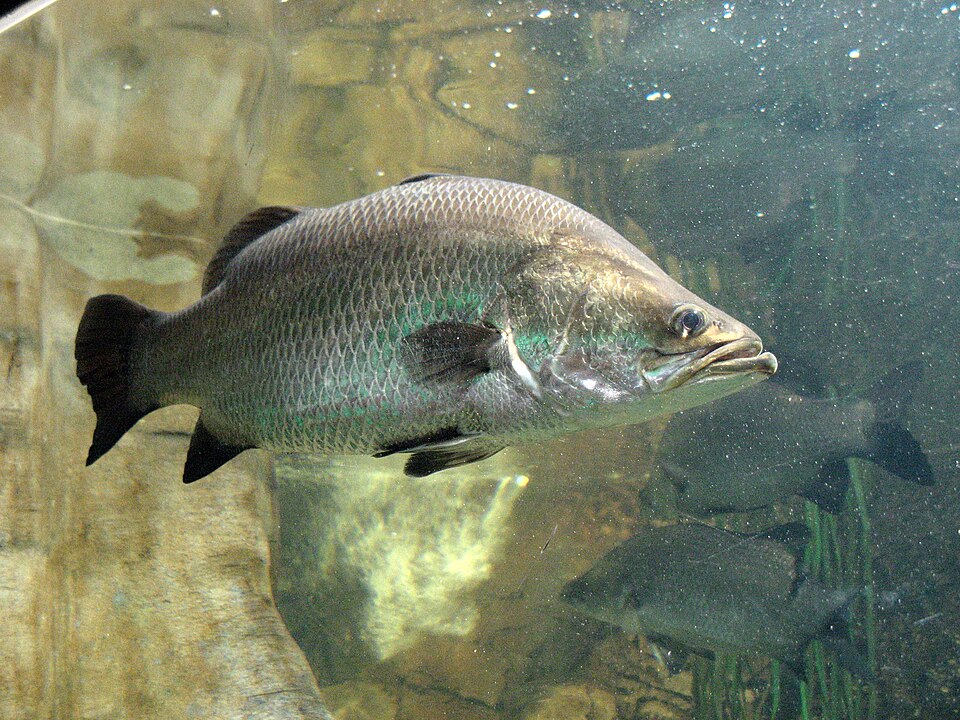
This reference uses the specific documents linked in the article and listed below. Check their scope, publication dates and the statements they support.
Animal at a glance
| Topic | Overview |
|---|---|
| Animal group | Lates calcarifer, also known as Asian sea bass |
| Production roles | Food fish and specialized hatchery or nursery stock |
| Life stages | Broodstock, early larvae, nursery fish and grow-out fish |
Identify the fish behind the market name
Barramundi and Asian sea bass refer here to Lates calcarifer. Other fish may also be sold under names containing sea bass, so the common name alone is an unreliable guide to husbandry. FAO's barramundi profile describes a fish that uses fresh, brackish and marine habitats and is grown in several production systems.
Broad salinity tolerance is useful but should not be mistaken for permission to make abrupt environmental changes. The fish's previous environment, size, health and acclimation arrangements matter when it enters a new unit. Ask the supplier for a receiving plan appropriate to the actual stock.
Hatchery larvae and nursery juveniles
Small barramundi begin life in a specialist hatchery environment before progressing through nursery and grow-out stages. Early feeding is a skilled task, and the food used for larvae is not the same as the ration fed to larger fish.
A grow-out enterprise should choose seed that matches its facilities. Very small fish require closer protection and more precise feeding than larger nursery juveniles. Receiving a larger number of smaller fish is not automatically better value if the farm cannot provide the next stage well.
In the nursery, size differences deserve prompt attention. Barramundi are predators, and larger juveniles can eat smaller fish. Appropriate grading, feed access and competent observation can therefore be important. Grading should still be purposeful: repeated rough handling can create its own losses.
A carnivorous fish needs an appropriate ration
Use a diet formulated for barramundi and the size being raised. Feed selection should consider nutrient balance and physical quality rather than relying only on a crude-protein percentage. A feed developed for another species may differ in digestibility, pellet behavior and nutritional suitability.
Distribute feed so that smaller or less dominant fish can reach it. Observe the response throughout the unit, not only the most active feeding corner. Uneven growth can reflect unequal access as well as the original size range.
Avoid replacing a complete ration casually with raw fish or waste materials. Those substitutions bring questions about freshness, disease exposure, environmental loading and whether the diet supplies all required nutrients. Where local production still uses such materials, the feeding plan needs qualified evaluation rather than an assumption that anything a predator will swallow is suitable.
Ponds, cages and recirculating tanks
FAO describes cage, pond and land-based culture. Each places a different responsibility on the farmer. A cage depends on exchange with the surrounding water. A pond relies on its managed environment and water supply. A recirculating unit depends heavily on equipment, oxygen provision and waste treatment.
Before increasing biomass, check the limiting component. More tank volume does not help if water treatment remains undersized. More cage fish can increase demand where currents are weak. More feed can increase waste faster than useful fish growth if appetite is already limited by the environment.
The Merck aquatic environmental-disease review identifies important water-related hazards. Its practical lesson is to investigate the environment whenever fish become unwell, while still considering infection or injury. A clean-looking tank does not establish that oxygen and dissolved wastes are acceptable.
Handling a strong, spiny fish
Plan captures and transfers with equipment intended for the fish's size and body form. Reduce avoidable net contact, crowding and waiting time. Barramundi have spines and sharp gill-cover structures, so staff protection and confident handling technique are part of a competent operation.
Prepare the receiving area before moving fish. A transfer should not leave animals confined while a blocked inlet is cleared or a suitable net is located. Avoiding those delays is a direct welfare improvement rather than an administrative detail.
Health and daily decisions
Sudden appetite loss, abnormal swimming, surface crowding, damaged skin or increasing deaths need prompt attention. Check system operation and water conditions, then involve an aquatic veterinarian or qualified fish-health specialist. The same outward sign may occur with several different causes.
Avoid selecting a treatment from a picture of an ulcer or a cloudy eye. A diagnostic assessment can prevent a farm from treating an infectious disease while missing oxygen stress, or changing water chemistry while an important infection continues to spread.
Does barramundi always need seawater grow-out?
No. The species is farmed in several salinity environments. The technical programme should fit the actual strain, life stage and facilities rather than assuming the common name sea bass requires one system.
Why do nursery fish need grading?
Where size variation permits larger fish to prey on smaller ones or dominate feed, a carefully planned grading programme can help. The decision and frequency should fit the group; grading is not beneficial simply because it appears on a calendar.
Continue with practical guidance
Field guides for this animal
Browse all Barramundi / Asian sea bass field guides for husbandry advice, health explanations and practical farm routines.
Cite this reference
LivestockDefense. “Barramundi / Asian sea bass: nursery feeding, grading and grow-out care.” Updated 2026-11-02. https://livestockdefense.com/animals/barramundi/
Add the date you accessed the page. This identifies the current reference; keep a permitted saved copy if your work depends on its exact wording. A citation alone does not establish support for a claim.
How to cite a page and its revision ↗Sources & boundaries
Read the evidence in context.
These documents support the statements identified in this reference. Check their scope and dates when deciding whether they answer your question.
- Merck Veterinary Manual: Environmental Diseases of Aquatic Animals in Aquatic Systems
Source update: 2026-06. Most recent check: 2026-10-30.
Document scope and recorded checks
Surface piping is compatible with low oxygen, and water-quality interpretation depends on species and system; no universal threshold, chemical correction or environmental manipulation recipe supplied. pH, carbonate conditions and other water variables need species- and system-specific interpretation; no chemical adjustment, sampling recipe or universal safe range supplied. Pond dissolved oxygen can vary across the day; water interpretation remains species- and system-dependent. No measurement protocol, threshold or corrective manipulation recipe supplied. Water-quality assessment matters and interpretation varies with species and system. No universal larval thresholds or corrective chemical procedures supplied. Nitrogenous compounds, pH and temperature need species/system context; rising pH can increase ammonia toxicity. No universal safe ranges, chemical correction, calculation recipe or test procedure supplied. Pond dissolved oxygen can vary over a day; water measurements require species/system and actual location/time context. No universal threshold, sampling schedule or water-correction procedure supplied.
Entries retain the date and scope of each recorded inspection.
- 2026-10-30 — Nitrogenous compounds, pH and temperature need species/system context; rising pH can increase ammonia toxicity. No universal safe ranges, chemical correction, calculation recipe or test procedure supplied.
Exact publisher page or indexed publisher text inspected for the bounded facts identified; no independent veterinary review implied
- 2026-10-30 — Pond dissolved oxygen can vary over a day; water measurements require species/system and actual location/time context. No universal threshold, sampling schedule or water-correction procedure supplied.
Exact publisher page or indexed publisher text inspected for the bounded facts identified; no independent veterinary review implied
- 2026-10-29 — Surface piping is compatible with low oxygen, and water-quality interpretation depends on species and system; no universal threshold, chemical correction or environmental manipulation recipe supplied.
Exact publisher page or indexed publisher text inspected for the bounded facts identified; no independent veterinary review implied
- 2026-10-29 — pH, carbonate conditions and other water variables need species- and system-specific interpretation; no chemical adjustment, sampling recipe or universal safe range supplied.
Exact publisher page or indexed publisher text inspected for the bounded facts identified; no independent veterinary review implied
- 2026-10-29 — Pond dissolved oxygen can vary across the day; water interpretation remains species- and system-dependent. No measurement protocol, threshold or corrective manipulation recipe supplied.
Exact publisher page or indexed publisher text inspected for the bounded facts identified; no independent veterinary review implied
- 2026-10-29 — Water-quality assessment matters and interpretation varies with species and system. No universal larval thresholds or corrective chemical procedures supplied.
Exact publisher page or indexed publisher text inspected for the bounded facts identified; no independent veterinary review implied
- 2026-10-30 — Nitrogenous compounds, pH and temperature need species/system context; rising pH can increase ammonia toxicity. No universal safe ranges, chemical correction, calculation recipe or test procedure supplied.
- FAO: Barramundi cultured species fact sheet
Source update: Not provided. Most recent check: 2026-11-02.
Bounded species biology, feeding context and production or husbandry statements attributed to this document in the animal overview sections. No numerical feeding, medication, restraint or breeding protocol reproduced.