
This reference uses the specific documents linked in the article and listed below. Check their scope, publication dates and the statements they support.
Animal at a glance
| Topic | Overview |
|---|---|
| Animal group | Chanos chanos, also commonly called bangus |
| Production roles | Food fish and nursery stock |
| Life stages | Seed, nursery fish, transferred juveniles and grow-out fish |
An animal adapted to several coastal environments
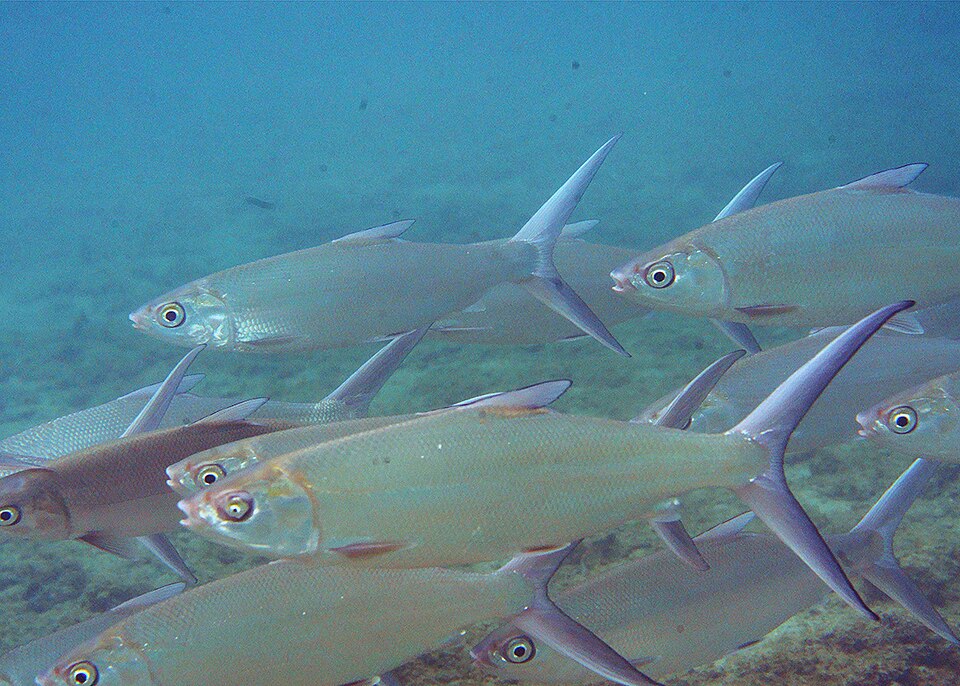
Milkfish are Chanos chanos. The name bangus is a familiar food and production name, not a different species. FAO's milkfish species profile describes juveniles using coastal nursery habitats and adults returning to marine environments. This life history helps explain why milkfish are grown in several kinds of water rather than in one universal pond type.
Euryhaline means able to use a range of salinities; it does not mean that a fish can be moved abruptly between any two waters without preparation. Hatchery, nursery and grow-out staff should coordinate changes in environment and transport with competent technical advice.
Hatchery seed and nursery survival
Larvae and very small fry need suitable food and protected rearing conditions. A nursery is an intermediate stage where small fish can be fed and observed more closely before moving to a larger production area. Hatchery seed and fish held through a nursery should not be judged as if they require identical placement conditions.
Before ordering, ask whether the receiving facility can handle the size being sold. Consider inlet protection, predator access, feeding equipment and how fish will be unloaded. The lowest purchase price is not useful if the seed is too small for the available facilities.
Reliable supply also means knowing whether a seller is the hatchery or an intermediary. This is worth resolving at purchase because it affects whom to ask about acclimation, early feeding and the stock's production history. The goal is to place healthy fish into a prepared unit, not to create a complicated paperwork exercise.
Natural pond food and formulated diets
Traditional milkfish ponds can rely partly on communities of algae and other natural food, including the bottom-growing assemblage often called lab-lab. The FAO regional milkfish review describes pond production context, while the species profile explains the expansion of formulated feeds.
The practical distinction is that a pond's food supply is a managed biological resource. More fish do not automatically create more food. If natural productivity is insufficient, growth may slow even when the fish appear active. A technical feeding plan should account for the system, the available natural food and the chosen production intensity.
Use stage-appropriate commercial feed where the production system calls for it. Feed form matters: fish must be able to find and consume the particles, and water movement must not carry the ration out of reach. Do not assume that a diet used successfully in a cage has the same role in a traditional shallow pond.
Pens and cages depend on the surrounding water
A pen uses part of an existing water body; a cage confines fish within a smaller enclosure. In both cases the farm depends on exchange with water it does not completely control. Suitable siting, maintained netting and a realistic stocking plan are therefore central husbandry decisions.
Look for areas where exchange may be poor and consider seasonal changes, nearby activities and the combined effect of multiple units. Increasing the feed input also increases what must be processed by the fish and surrounding environment. A larger visible water area is not proof of unlimited capacity.
In ponds, the operator may have more direct influence over water level and exchange, but also responsibility for the entire pond food web. A change in water color, a poor feeding response or fish gathering unusually at the surface should prompt investigation.
Handling and production welfare
Milkfish can be active during capture and transfer. Prepare the receiving system and keep handling purposeful. Netting, sorting and transport should be planned to limit avoidable abrasion, crowding and exposure to unsuitable water.
Partial harvesting can help some enterprises meet their market, but each operation disturbs the remaining fish. Plan it around fish condition and the capacity to restore a stable environment afterward. The decision should serve animal care and production needs rather than become an unnecessary routine.
When growth or survival deteriorates
Appetite loss, recurring mortality, poor swimming or visible injuries require more than a change of feed brand. Assess the water system and obtain fish-health advice. A supplier, extension specialist or aquatic veterinarian can help determine whether the problem involves nutrition, environment, handling or disease.
Avoid interpreting a single low harvest as evidence that the species is unsuitable. First establish where the production chain lost performance: seed quality, placement survival, nursery growth, grow-out feeding or the final handling period. That is a practical way to choose an improvement without prescribing the same remedy to every farm.
Can bangus live on natural pond food alone?
Some established pond systems use natural productivity substantially. The answer depends on fish density, stage, the pond's food supply and the desired output. It is not a sound assumption for every pen, cage or intensive unit.
Is a nursery always a separate business?
No. It can be a separate facility or a stage within the same farm. What matters biologically is that small fish receive suitable protection and feeding before they enter the next environment.
Continue with practical guidance
Field guides for this animal
Browse all Milkfish field guides for husbandry advice, health explanations and practical farm routines.
Cite this reference
LivestockDefense. “Milkfish / bangus farming: pond food, nursery care and grow-out systems.” Updated 2026-11-02. https://livestockdefense.com/animals/milkfish/
Add the date you accessed the page. This identifies the current reference; keep a permitted saved copy if your work depends on its exact wording. A citation alone does not establish support for a claim.
How to cite a page and its revision ↗Sources & boundaries
Read the evidence in context.
These documents support the statements identified in this reference. Check their scope and dates when deciding whether they answer your question.
- FAO: Milkfish culture development in the South Pacific
Source update: Not provided. Most recent check: 2026-11-02.
Bounded species biology, feeding context and production or husbandry statements attributed to this document in the animal overview sections. No numerical feeding, medication, restraint or breeding protocol reproduced.
- FAO: Milkfish cultured aquatic species fact sheet
Source update: Not provided. Most recent check: 2026-11-02.
Species biology, life stages and the bounded practical husbandry facts cited in the aquatic animal overview or supporting guide; no drug dose, invasive procedure, universal stocking rate or complete clinical protocol.