
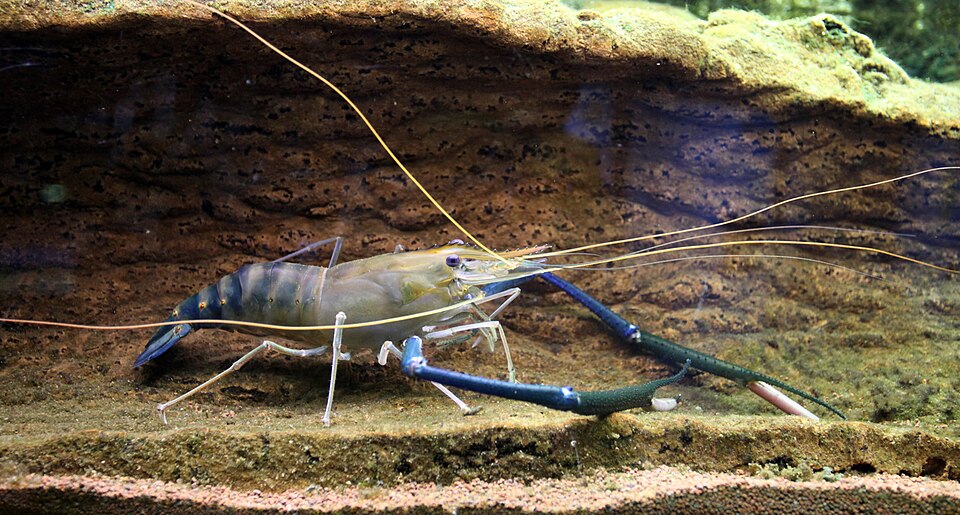
Giant freshwater prawn: the water requirement changes with development
- Egg-carrying females
Broodstock produce the eggs that will hatch into larvae.
- Larvae
Free-swimming development in suitable brackish hatchery water.
- Postlarvae and nursery
After metamorphosis, a more bottom-associated stage can enter freshwater care.
- Grow-out
Freshwater production with suitable food, habitat and oxygen.
This reference uses the specific documents linked in the article and listed below. Check their scope, publication dates and the statements they support.
Animal at a glance
| Topic | Overview |
|---|---|
| Animal group | Macrobrachium prawns, including giant river prawn |
| Production roles | Food prawns and hatchery or nursery stock |
| Life stages | Egg, brackish-water larva, post-larva and later grow-out |
Freshwater describes only part of the life cycle
The name giant freshwater prawn can mislead a new producer. FAO's giant river prawn profile explains that larvae develop in brackish water, then become postlarvae that adopt a more bottom-associated way of life and move toward freshwater. The salinity requirement changes with development; it is not a preference that can be ignored to simplify the farm.
This means that breeding, larval culture and freshwater grow-out are distinct technical activities. A farmer can operate a freshwater nursery or grow-out pond while purchasing postlarvae from a specialist hatchery. Owning broodstock does not automatically make the facility capable of producing suitable seed.
Hatchery larvae and early food
Free-swimming larvae require appropriate live or prepared foods and carefully managed water. The food, particle behavior and feeding method differ from those used for larger prawns. Hatchery expertise includes maintaining suitable conditions through several developmental stages, not simply adding salt to a grow-out tank.
FAO's freshwater prawn farming manual separates hatchery, holding, nursery and grow-out phases. That structure is useful when planning an enterprise: first decide which biological stage the business will manage, then select the equipment and skills it requires.
When buying postlarvae, ask whether metamorphosis is complete and what receiving conditions the supplier recommends. Arrange acclimation with competent technical support. A container of young stock should not arrive before the nursery water, feed, protection and staff are ready.
Nursery care prepares small prawns for a larger environment
A nursery allows close care of small postlarvae before they enter grow-out. It can improve the match between animal size and the next facility, but it creates its own feeding and water-management responsibilities. Small stock should not be placed into a large environment on the assumption that hard-to-see animals will look after themselves.
Suitable surfaces can expand usable habitat in some systems. They need to be safe, serviceable and positioned so water and food remain available. More material is not automatically better if it blocks exchange, traps waste or makes inspection impossible.
Protection from escape and predators should fit the small size and behavior of the animals. Inspect screens and outlets before stocking, not after the first unexplained loss. A receiving nursery is successful when the prawns can live, feed and progress to the next stage without avoidable disruption.
Grow-out feeding and unequal sizes
Giant freshwater prawns are bottom-associated animals, and food should reach usable areas. Select a ration suited to the species, size and culture system. Distribution matters because food concentrated in a few places can favor dominant animals and leave others with poor access.
Growth is not uniform. Male forms and social interactions contribute to a broad size range within a group, so a simple average can hide smaller prawns or a few very large individuals. Management may involve suitable harvesting or size-management strategies developed for the actual system rather than a promise that every animal will reach one size together.
Do not solve uneven growth by increasing feed indefinitely. First examine whether the animals can reach the feed, whether the environment supports their appetite and whether size differences are part of the species' normal production biology. A specialist can help distinguish these possibilities.
Moulting and safe habitat
Prawns grow by shedding their external covering. Newly moulted individuals are more vulnerable, which makes habitat, unnecessary handling and interactions with larger animals important husbandry considerations. Avoid treating a soft individual as an invitation to handle it for demonstration.
Harvest and transfers should be planned to reduce injury and prolonged crowding. Containers and equipment need to accommodate long appendages and the animal's body form. Prepare the receiving water and habitat first so the operation can proceed without avoidable waiting.
Water quality, oxygen and seasonal suitability
Freshwater does not mean any water source is suitable. The farm needs an assessed supply and a production plan that considers oxygen, temperature, waste and the local season. Aeration and water movement should reach the animals' habitat, not only create activity near one edge of the unit.
A decline in feeding, abnormal behavior or unexpected mortality warrants a review of the environment and aquatic-health advice. Replacing a feed or adding a chemical without identifying the problem can delay the response that the prawns need.
Can giant freshwater prawn larvae be raised in ordinary freshwater?
Not as a substitute for the species' brackish larval requirements. The later freshwater stage should not be projected backward onto larval development.
Can a grow-out farm avoid operating a hatchery?
Yes. A competent specialist seed supplier can provide postlarvae for a prepared nursery or grow-out operation. The receiving farm still needs appropriate stock assurance, acclimation and husbandry.
Continue with practical guidance
- Separate freshwater-prawn hatchery and grow-out needs
- White tail disease in freshwater prawns
- Browse all livestock and food animals
Practical husbandry guides
Field guides for this animal
Browse all Freshwater prawns field guides for husbandry advice, health explanations and practical farm routines.
Cite this reference
LivestockDefense. “Freshwater prawn farming: brackish-water larvae, nurseries and grow-out care.” Updated 2026-11-02. https://livestockdefense.com/animals/freshwater-prawns/
Add the date you accessed the page. This identifies the current reference; keep a permitted saved copy if your work depends on its exact wording. A citation alone does not establish support for a claim.
How to cite a page and its revision ↗Sources & boundaries
Read the evidence in context.
These documents support the statements identified in this reference. Check their scope and dates when deciding whether they answer your question.
- FAO: Giant river prawn cultured species fact sheet
Source update: Not provided. Most recent check: 2026-11-02.
Bounded species biology, feeding context and production or husbandry statements attributed to this document in the animal overview sections. No numerical feeding, medication, restraint or breeding protocol reproduced.
- FAO: Farming freshwater prawns: a manual for giant river prawn culture
Source update: Not provided. Most recent check: 2026-11-02.
Species biology, life stages and the bounded practical husbandry facts cited in the aquatic animal overview or supporting guide; no drug dose, invasive procedure, universal stocking rate or complete clinical protocol.
- FAO: Farming freshwater prawns: hatchery phase
Source update: Not provided. Most recent check: 2026-11-02.
Species biology, life stages and the bounded practical husbandry facts cited in the aquatic animal overview or supporting guide; no drug dose, invasive procedure, universal stocking rate or complete clinical protocol.
- FAO: Farming freshwater prawns: postlarval holding and nursery phases
Source update: Not provided. Most recent check: 2026-11-02.
Species biology, life stages and the bounded practical husbandry facts cited in the aquatic animal overview or supporting guide; no drug dose, invasive procedure, universal stocking rate or complete clinical protocol.
- FAO: Farming freshwater prawns: grow-out phase
Source update: Not provided. Most recent check: 2026-11-02.
Species biology, life stages and the bounded practical husbandry facts cited in the aquatic animal overview or supporting guide; no drug dose, invasive procedure, universal stocking rate or complete clinical protocol.